The archive / Himalayan Art / Green Tara
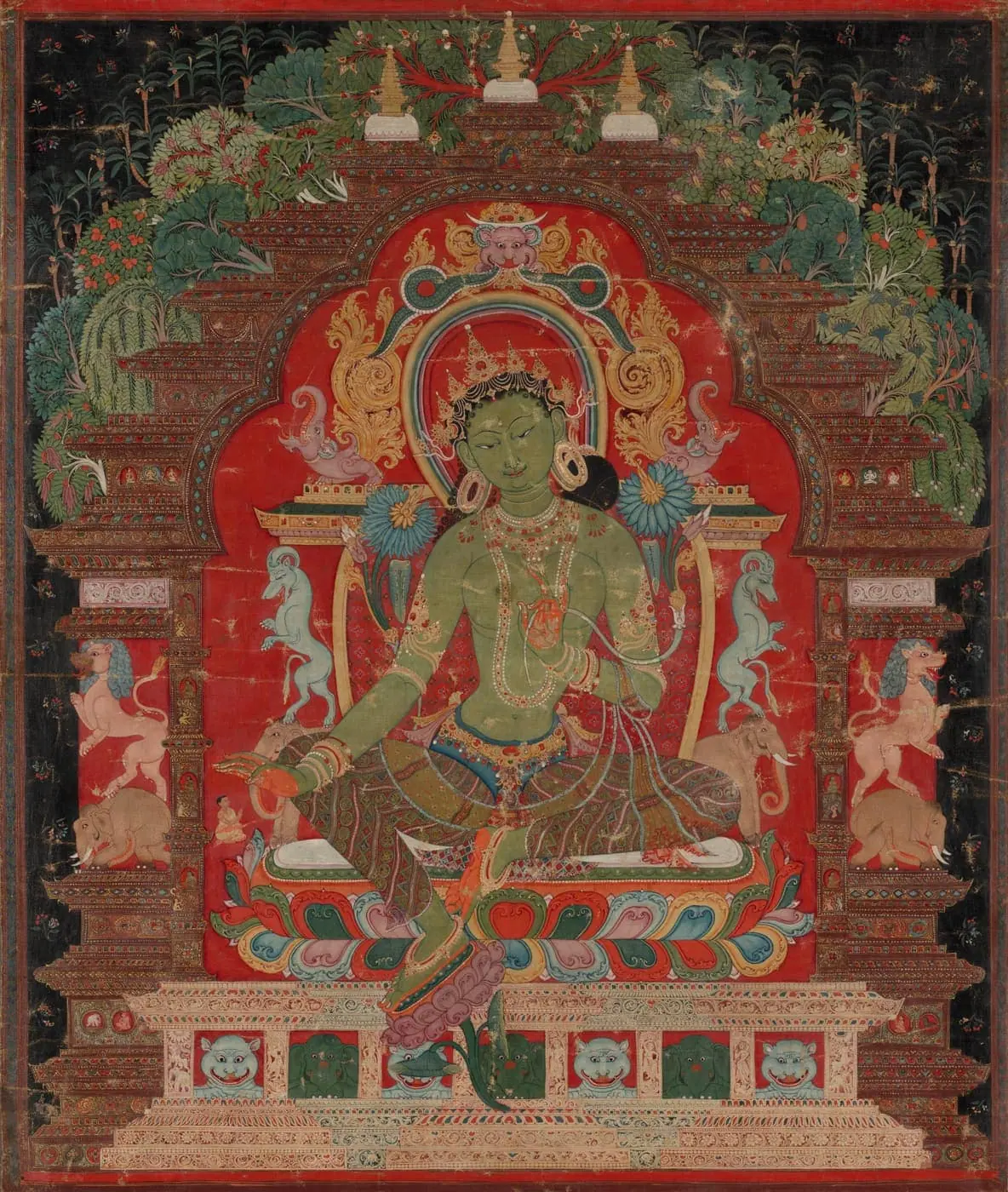
Green Tara
Unknown, Central Tibet · attributed to Aniko
3 variations + a matched story print, every standard frame ratio. sRGB · up to 300 DPI · personal-use license.
Print it your way — at home, a local shop, or a gallery print delivered to your door. See the printing guide →
Part of The Gold Wall — 3 prints, one $18 download.
Sizes in the download
Print-ready files at every standard frame ratio below — the full image, nothing cropped:
The print is crisp at 300 DPI up to about 30×40″, and stays sharp at 150 DPI from across the room, out to about 40×60″.
[ Will it fit your frame? ]
THE WORK
A goddess with one foot already off the throne.
Look at her right leg. It hangs down off the lotus seat while the left stays folded in meditation — the posture of royal ease, and the whole point of it. Green Tara is not settled on her throne; she is shown the instant before she rises. In Tibetan Buddhism she has a job: she dispels fear and gives protection, and the lowered foot says she is ready to step into the world and do it. Her right hand turns palm-out in the fear-not gesture. The flat, saturated green of her skin and the gold of her ornaments sit against a deep ground, and a confident, lilting line carries the whole figure. It is calm and it is alert at once.
LOOK CLOSER
The painting is a tool, and the words are on the back.
This is a thangka — a Tibetan devotional painting on cloth — and it was made to be used, not only admired. Tara's mantra is inscribed on the reverse of the panel, the side a viewer never sees; the image works whether or not you can read it. The iconography is exact. Her green skin and fear-not gesture link her to the cosmic Buddha of the North, Amoghasiddhi, enshrined in the niche directly above her head. Lower down, a tiny monastic figure kneels beneath her hand — the monk who commissioned the painting, written into the picture he paid for. Nothing here is decorative by accident; every part is doing devotional work.
CENTRAL TIBET, c. 1260s
Among the oldest paintings we carry — and the moment 'Tibetan' art was being fixed.
By age this is the earliest work in the collection, set down on cotton in central Tibet around the 1260s, roughly two centuries before anything else here. It belongs to a pivotal moment: Newar masters from the Kathmandu Valley were carrying their style north, and out of that exchange the look we now call Tibetan painting took shape. The hand has long been attributed to the celebrated Newar artist Aniko, who worked in Tibet in the later 1200s — though that attribution is disputed, and the surest thing to say is that this is one of the most beautiful Tibetan paintings of its century. A calm, protective image like this asks for a quiet wall. The master file prints generously, but its luminous, hand-laid colour rewards a near view as much as a large one.
Her green color and fear-not gesture link her to the cosmic Buddha of the North, enshrined above her head.— The Cleveland Museum of Art, on Green Tara
The file & the facts
- Title
- Green Tara
- Artist
- Unknown, Central Tibet
- Year
- c. 1260s
- Medium
- Tempera & gold on cotton
- Original
- 107 × 65 cm (mounted)
- Collection
- The Cleveland Museum of Art
- Rights
- Public-domain painting · open access · The Cleveland Museum of Art — Purchase from the J. H. Wade Fund by exchange, 1970.156 (CC0, courtesy)
- File
- sRGB · JPEG · 150–300 DPI


