The archive / Medieval / Madonna and Child
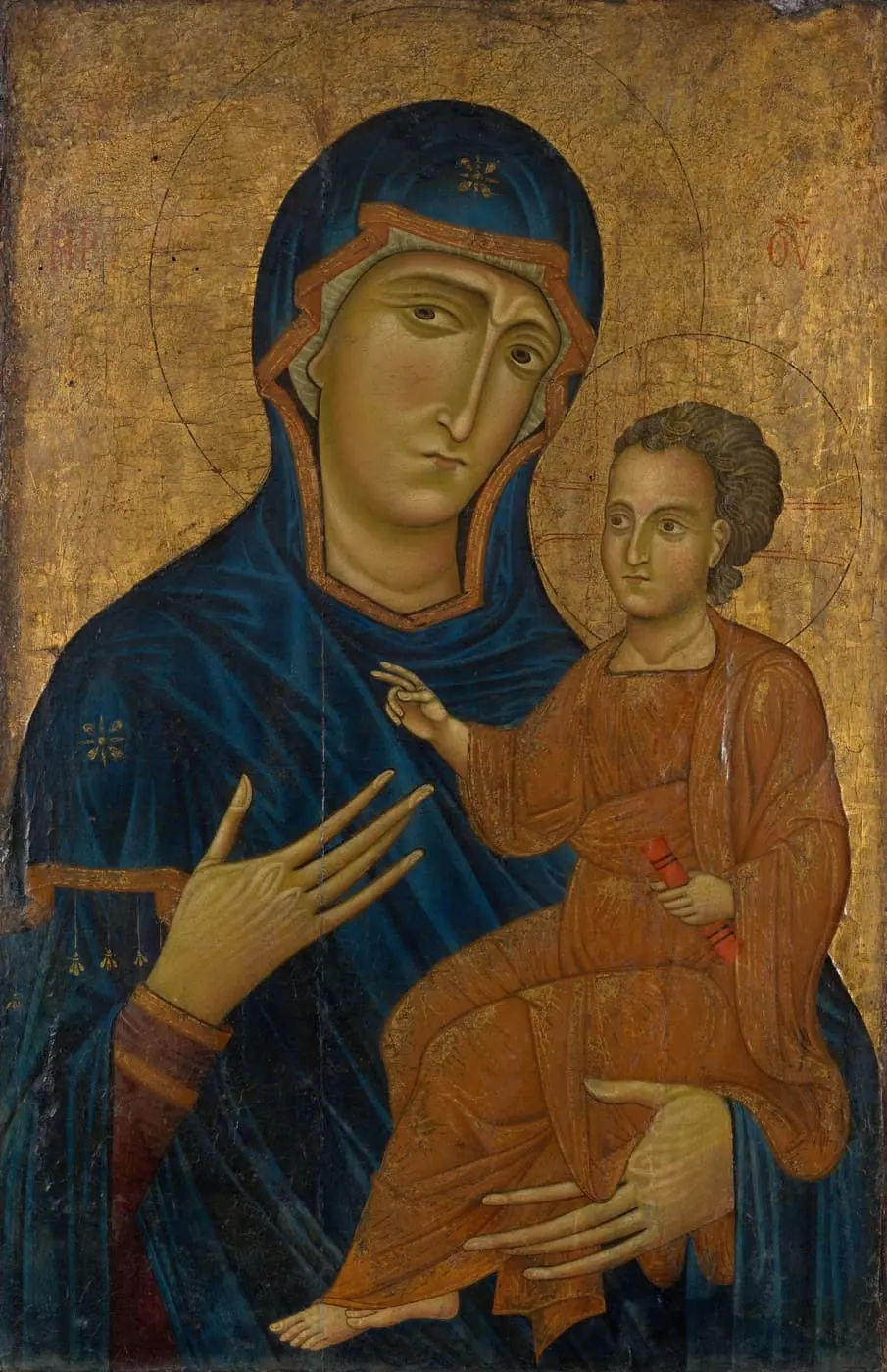
Madonna and Child
Berlinghiero · Italian, Lucca, active by 1228 – died by 1236
Coming soon. Be first to know when it’s ready.
Emails sent via Kit · Privacy
3 variations + a matched story print, every standard frame ratio. sRGB · up to 300 DPI · personal-use license.
Print it your way — at home, a local shop, or a gallery print delivered to your door. See the printing guide →
Sizes in the download
Print-ready files at every standard frame ratio below — the full image, nothing cropped:
Every size here is print-ready, sharp at viewing distance. Up close, the print is crispest at 300 DPI up to about 5×7″; at larger sizes the cream mat carries the print to the frame while the painting sits at its sharpest within.
[ Will it fit your frame? ]
THE WORK
There is no shadow anywhere on her.
Look for the place where the light falls off and you won't find it. Berlinghiero gives the Virgin no rounded cheek, no modelled fold, no cast shadow to set her into a room. Her blue robe lies flat against a wall of burnished gold, and the halos are not painted but scored straight into the metal with a tool, ringed and incised. Holiness here is carried by the gold itself and by the long, sure line that draws her — the manner Italians later called the maniera greca, the Greek manner, learned from Byzantine icons. This is what sanctity looked like before painters decided it should look like a person standing in real light.
LOOK CLOSER
Her hand is pointing, and that is the whole subject.
Follow her right hand. It turns out toward us, then gestures across to the child on her arm — not a casual hold but a precise, named act. This is the Byzantine type the Met calls the Hodegetria, "she who shows the way": the Virgin presents the infant Christ as the way to salvation, and the picture is built around that single gesture. The child answers in kind, raised in blessing and holding a scroll, robed less like a baby than like a small grave adult. The reading is the type's, not an inscription on the panel — but once you see the pointing hand, the painting reorganises around it. She is not cradling him. She is directing you to him.
LUCCA, POSSIBLY THE 1230s
The last word before the Renaissance changed the sentence.
This is one of the oldest things we carry, and it sits on a hinge. Berlinghiero worked in Lucca, the foremost painter of his Tuscan city, in the decades the Met dates to possibly the 1230s — the museum keeps the "possibly," and so do we, since a panel this old rarely hands over a firm year. He is also nearly anonymous: this is one of only two paintings securely given to his hand, both anchored to a single crucifix he signed. What makes it worth a long look is timing. A generation later Cimabue and then Giotto would begin rounding figures with shadow and setting them in believable space, and Western painting would turn. Berlinghiero is the moment just before that turn, when heaven was still, plainly, made of metal.
This composition is of the Byzantine type known as the Hodegetria, which may be translated as 'One Who Shows the Way,' as the Madonna points to Christ as the way to salvation.The Metropolitan Museum of Art, on Berlinghiero's Madonna and Child
The file & the facts
- Title
- Madonna and Child
- Artist
- Berlinghiero
- Year
- c. 1230s
- Medium
- Tempera and gold on wood
- Original
- 80.3 × 53.7 cm (overall)
- Collection
- The Metropolitan Museum of Art
- Rights
- Public-domain painting · open access · The Metropolitan Museum of Art — Gift of Miss Harriet Barnes Pratt, in memory of her father, Charles Millard Pratt, 1950 (60.173) (CC0, courtesy)
- File
- sRGB · JPEG · 150–300 DPI


