The archive / Rococo / Still Life with a White Mug
Still Life with a White Mug
Jean-Siméon Chardin · French, 1699–1779
Coming soon. Be first to know when it’s ready.
Emails sent via Kit · Privacy
3 variations + a matched story print, every standard frame ratio. sRGB · up to 300 DPI · personal-use license.
Print it your way — at home, a local shop, or a gallery print delivered to your door. See the printing guide →
Sizes in the download
Print-ready files at every standard frame ratio below — the full image, nothing cropped:
The print is crisp at 300 DPI up to about 16×20″, and stays sharp at 150 DPI from across the room, out to about 30×40″.
[ Will it fit your frame? ]
The work
A kitchen shelf, given the weight of history.
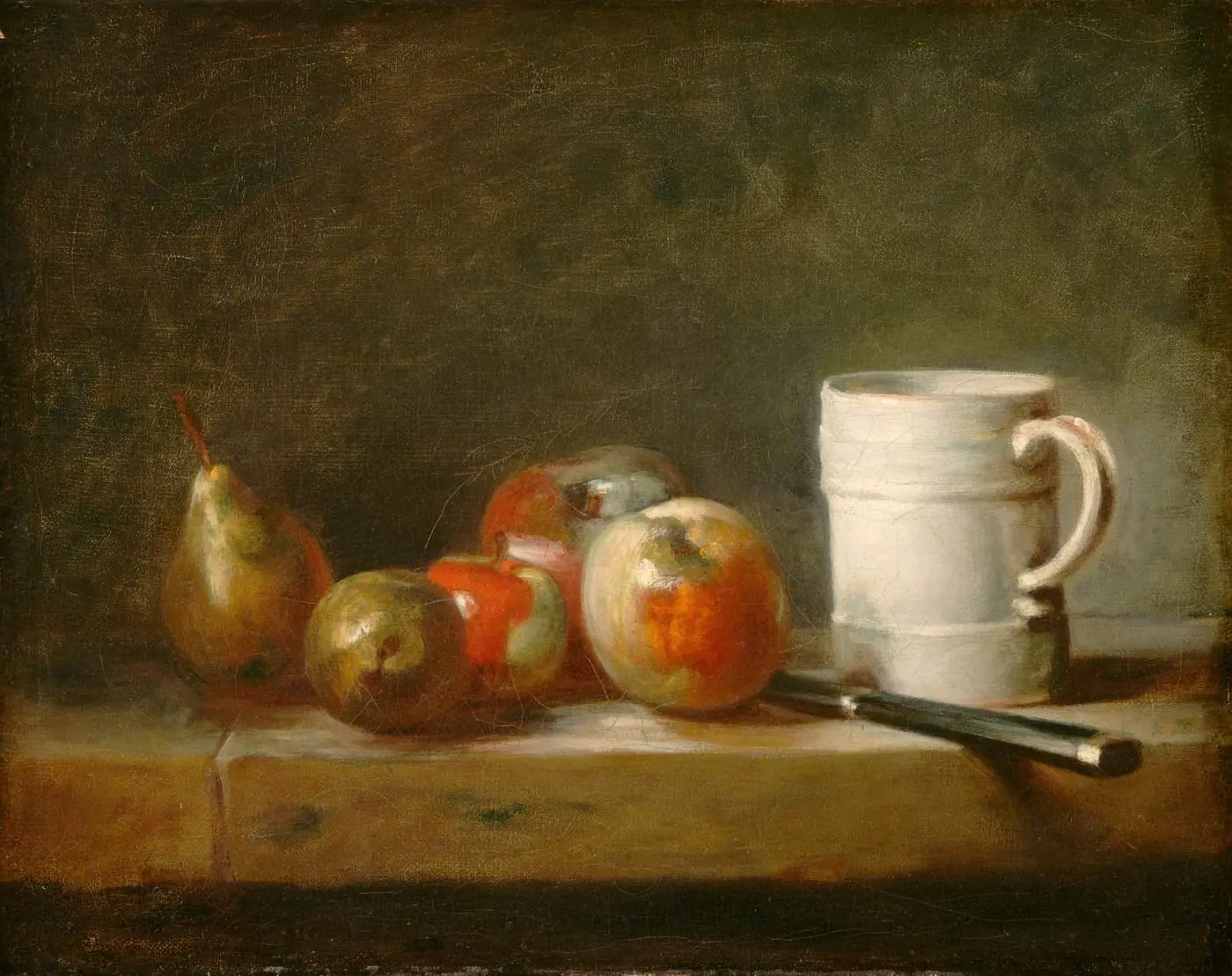
Two pears sit at the left — one standing, one lying on its side with its stem turned toward you — and a few apples to the right, beside a knife whose dark handle juts out over the ledge. Behind them stands a white earthenware mug, lit from the left on a bare stone slab. Nothing happens, and that is the point. In the Paris of Boucher and Fragonard, where painting meant goddesses and garden flirtation, Chardin set down the plainest things in the house and painted them with the gravity reserved for saints and kings. He called this nature morte — dead nature; he made it monumental.
Look closer
It is built from touch, not from line.
Move in on the mug and the smooth white surface breaks into grains. Chardin scumbled his paint, dragging a thin, broken layer over what lay beneath, so the matte of an apple's skin and the dull sheen of the glaze are made of texture, not outline. There are almost no drawn edges here. Step back and it resolves into solid things in real light; step close and it is frank, granular paint. Diderot caught it in his Salon of 1763: not white, red, and black ground on the palette, he wrote, but "the very substance of things," air and light fixed on the canvas with the tip of the brush.
Why it matters
The real subject is attention.
Still life sat at the very bottom of the academic hierarchy — below history, portrait, genre, and landscape — the genre of mere things. Chardin spent a career quietly disproving the order, painting fruit and crockery until they held as much presence as a face. His admirer Diderot, the most influential critic of the age, championed exactly this gravity, calling him a magician of silent compositions. What Chardin asks of you is simple and rare: look at the ordinary long enough, and it stops being ordinary. The mug, c. 1764, hangs at the National Gallery of Art in Washington.
So here you are again, great magician, with your silent compositions!Denis Diderot, on Chardin, Salon of 1765
The file & the facts
- Title
- Still Life with a White Mug
- Artist
- Jean-Siméon Chardin
- Year
- c. 1764
- Medium
- Oil on canvas
- Original
- 33.1 × 41.2 cm
- Collection
- National Gallery of Art, Washington
- Rights
- Public-domain painting · open access · National Gallery of Art, Washington (obj. 53124) (CC0, courtesy)
- File
- sRGB · JPEG · 150–300 DPI


