The archive / Baroque / The Floating Feather
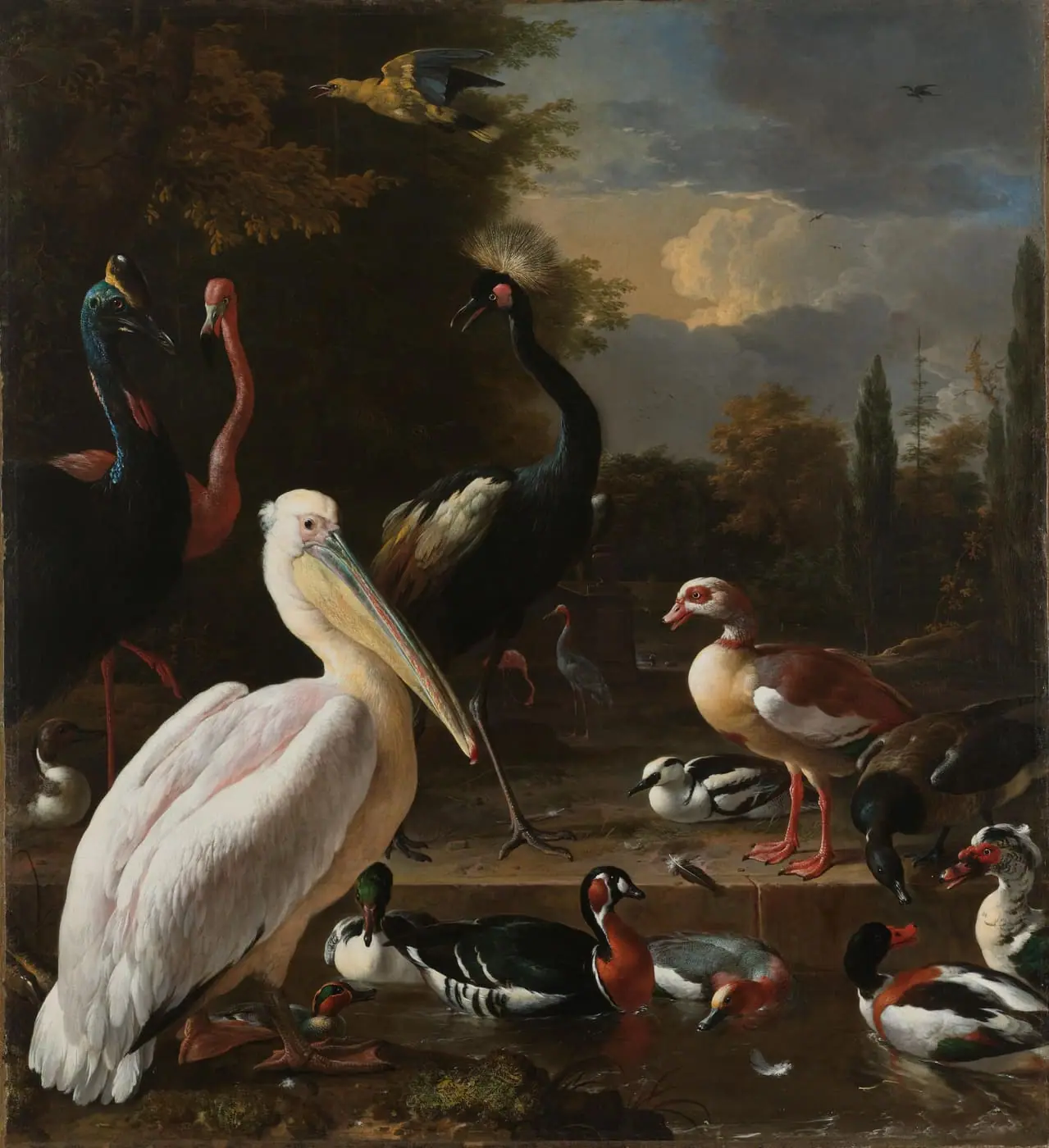
The Floating Feather
Melchior d'Hondecoeter · Dutch, 1636–1695
Coming soon. Be first to know when it’s ready.
Emails sent via Kit · Privacy
3 variations + a matched story print, every standard frame ratio. sRGB · up to 300 DPI · personal-use license.
Print it your way — at home, a local shop, or a gallery print delivered to your door. See the printing guide →
Sizes in the download
Print-ready files at every standard frame ratio below — the full image, nothing cropped:
Every size here is print-ready, sharp at viewing distance. Up close, the print is crispest at 300 DPI up to about A3; at larger sizes the cream mat carries the print to the frame while the painting sits at its sharpest within.
[ Will it fit your frame? ]
THE WORK
A calm pond that never existed.
A great white pelican turns at the edge of the water, and the whole scene reads as a quiet afternoon in a palace garden. Look at who else is there. The cassowary at the left came from the East Indies, the flamingo from the Americas, the crowned crane from Africa — birds carried halfway round the world, none of which would ever have shared a pool. Hondecoeter gathered them anyway, on a near-square canvas. The diagonal of the bank carries your eye past the pelican's bright white mass into cool, dim woods. The serenity is the performance.
WHY IT MATTERS
Empire, painted to look like a garden.
This is a gevogelte-stuk, a Dutch bird-piece, but each bird here also carried a price and a provenance. They were status symbols, the kind of living exotica a wealthy republic and its rulers kept in private menageries, proof of how far Dutch ships now reached. The painting was probably made for the stadholder William III, for the palace at Het Loo. So the calm is a kind of accounting: wealth, curiosity and dominion over three continents, set down as a pond you could stand beside. Le Stampe sells that same flamingo as Audubon drew it a century and a half later, a scientific specimen rather than a sovereign's trophy.
LOOK CLOSER
The whole picture is named after a feather.
Find the small white down feather drifting on the surface of the pool, near the foreground. That detail, not the pelican, gave the painting the name it goes by — The Floating Feather. No record explains why Hondecoeter weighted it so, and it is safer not to invent one. Prize it instead as a passage of almost nothing, a few soft strokes laid on still water, the moment a painter who could marshal three continents of birds chose to show what he could do with a single feather. The boast is hidden in the quietest mark on the canvas.
Three continents of birds gathered at one pool that never existed — and the painting takes its name from a single feather.
The file & the facts
- Title
- The Floating Feather
- Artist
- Melchior d'Hondecoeter
- Year
- c. 1680
- Medium
- Oil on canvas
- Original
- 159 × 144 cm
- Collection
- Rijksmuseum, Amsterdam
- Rights
- Public-domain painting · open access · Rijksmuseum, Amsterdam (SK-A-175) (CC0, courtesy)
- File
- sRGB · JPEG · 150–300 DPI


