The archive / Pointillism / A Sunday on La Grande Jatte
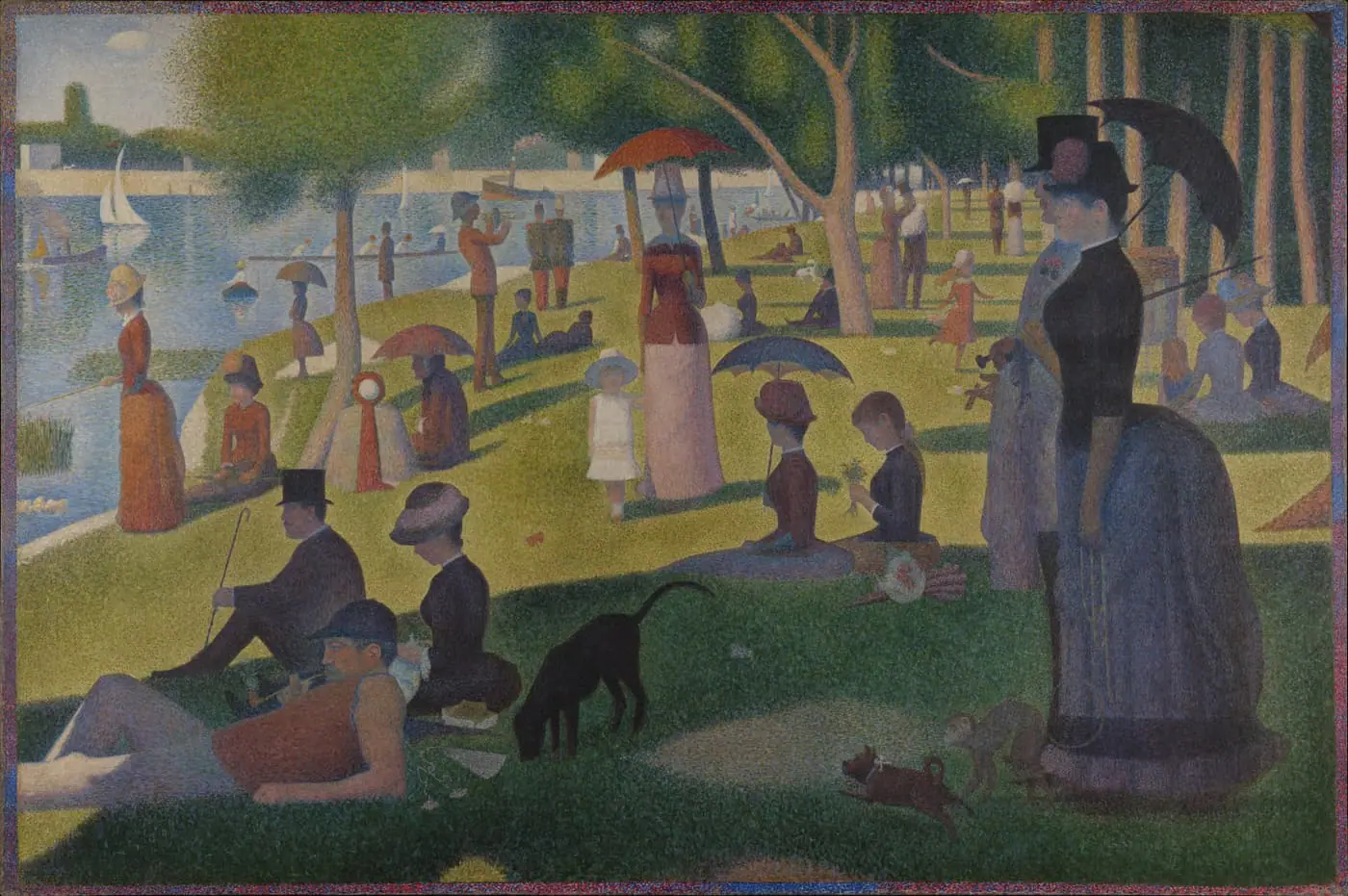
A Sunday on La Grande Jatte
Georges Seurat · 1859–1891
3 variations + a matched story print, every standard frame ratio. sRGB · up to 300 DPI · personal-use license.
Print it your way — at home, a local shop, or a gallery print delivered to your door. See the printing guide →
Sizes in the download
Print-ready files at every standard frame ratio below — the full image, nothing cropped:
The print is crisp at 300 DPI up to about 24×36″, and stays sharp at 150 DPI from across the room, out to about 40×60″.
[ Will it fit your frame? ]
The work
A summer afternoon built from millions of dots.
Step close and the figures dissolve into separate dabs of colour, dots and dashes set side by side rather than blended on the palette. Seurat trusted the eye to do the mixing, so that two complementary touches read as one brighter hue. He called the method Pointillism and grounded it in optical and colour theory. The riverbank scene is large, 207.5 by 308.1 cm, and it took more than seventy preliminary oil sketches and drawings to arrive.
Why it matters
The painting that launched a movement.
In 1886 the canvas hung at the eighth and final Impressionist exhibition in Paris, and Seurat left it the leader of something new. The critic Félix Fénéon supplied the word that same year. He called it Neo-Impressionism.
Look closer
He kept reworking it for years.
Run your eye to the very edge and you find a band of small coloured dots, painted around 1888-89 to ease the picture into its frame. Seurat had gone back in earlier too, sharpening silhouettes and adding figures, among them the monkey on a leash. Not everyone was charmed. Reception split sharply, and J.-K. Huysmans dismissed the figures as lifeless beneath their speckled surface.
Art is Harmony. Harmony is the analogy of opposites, the analogy of similarities of tone, of tint, of line taking account of a dominant and under the influence of the lighting, in combinations that are gay calm or sad.— Georges Seurat, letter to Maurice Beaubourg, 1890
The file & the facts
- Title
- A Sunday on La Grande Jatte
- Artist
- Georges Seurat
- Year
- 1884–86
- Medium
- Oil on canvas
- Original
- 207.5 × 308.1 cm
- Collection
- Art Institute of Chicago
- Rights
- Public-domain painting · open access · Art Institute of Chicago — Helen Birch Bartlett Memorial Collection, 1926.224 (CC0, courtesy)
- File
- sRGB · JPEG · 150–300 DPI


