The archive / Minhwa / Tiger Family
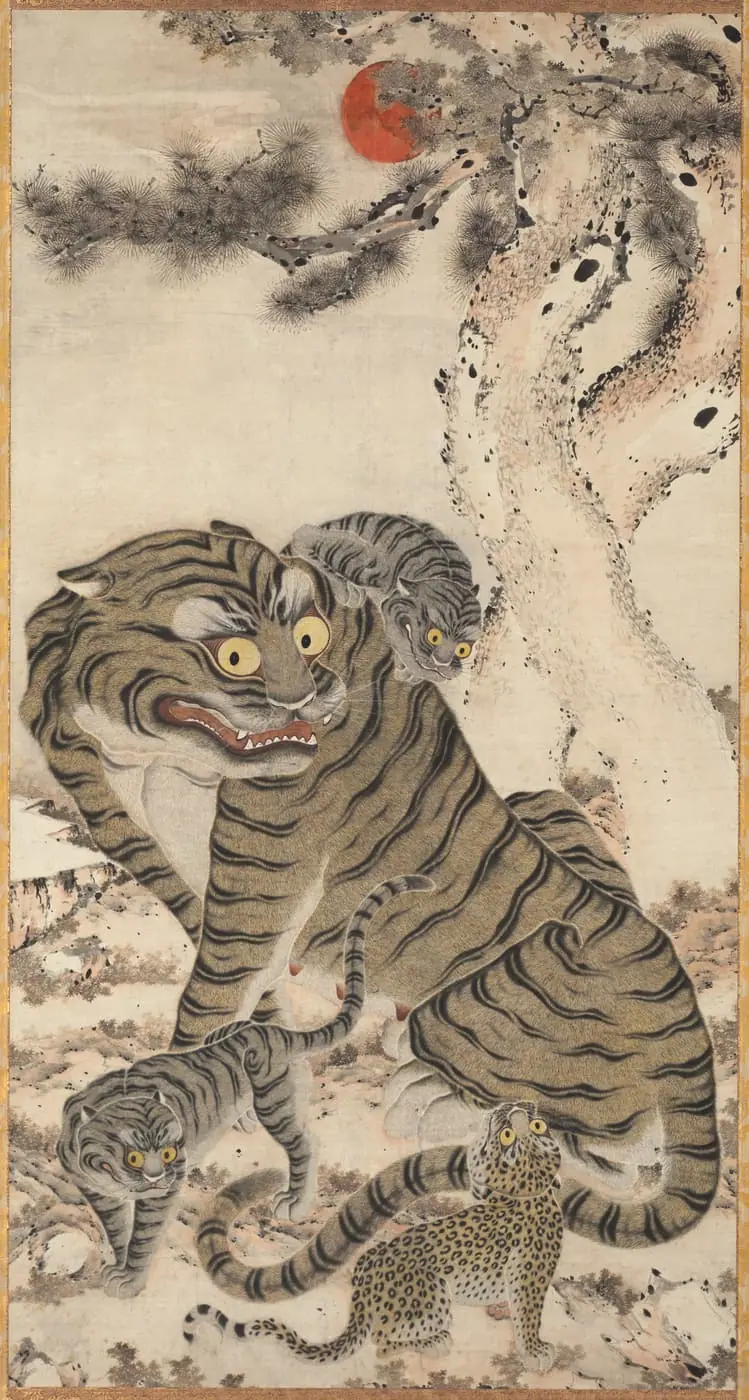
Tiger Family
Unknown, Joseon Korea · Korea, Joseon dynasty (1392–1910)
3 variations + a matched story print, every standard frame ratio. sRGB · up to 300 DPI · personal-use license.
Print it your way — at home, a local shop, or a gallery print delivered to your door. See the printing guide →
Sizes in the download
Print-ready files at every standard frame ratio below — the full image, nothing cropped:
The print is crisp at 300 DPI up to about A3, and stays sharp at 150 DPI from across the room, out to about 24×36″.
[ Will it fit your frame? ]
THE WORK
A tiger with a foolish, grinning face, looking down a six-foot scroll.
Start with her face. The tigress sits high on the scroll, her wide gold eyes set just off true — wall-eyed, the pupils not quite tracking — so the stare that should menace you reads instead as a sweet, dim grin. That comic register has a name and a tradition in Korea: the babo horangi, the "idiot tiger," the snarling court beast drawn soft and a little cross-eyed, the warm opposite of the fearsome original. Two cubs nestle against her — one curled at her shoulder, one stepping in below. The spotted cat tucked at lower right is not a third tiger but a leopard — long mistaken in Korea for a baby tiger, and so painted as one of the family. Above them, a red morning sun hangs behind a knotted pine.
WHAT IT IS FOR
Not a court treasure — a doorway charm against bad luck.
This is minhwa, folk painting: cheap, anonymous, made for ordinary homes, the opposite of the literati scroll. As the Cleveland Museum notes, the fearsome tiger was traditionally pasted on entrance doors at New Year to ward off evil spirits — held to keep misfortune out for the year. Every part pulls its weight: the pine means long life, the cubs prosperity, the leopard good fortune. The satire most people love — the dim, swaggering tiger as a jab at the pompous yangban gentry — is a popular reading, not settled fact, and it belongs most firmly to the magpie-and-tiger pictures. There is no magpie here; as the museum puts it, the crimson sun is placed behind a majestic pine instead.
ON A WALL
Warm, funny, and unusually tall.
Most old art that ends up framed is solemn. This one is built to make you smile — a fierce thing rendered tender, which is a rare register on a wall and an easy one to live beside. It earns a kitchen, a child's room, an entryway. Mind the shape: the painting is a tall scroll, near twice as high as it is wide, so it suits a 2:3 or A-series portrait frame, or a 3:4 crop that trims the empty sky and keeps every animal. It will not take a square or a wide frame without cutting the family apart — a long, narrow stretch of wall is its natural home.
This is not merely a playful scene but a well calculated image with symbols of longevity (pine trees), prosperity (tigress and cubs), and good fortune (leopard).— The Cleveland Museum of Art, on Tiger Family
The file & the facts
- Title
- Tiger Family
- Artist
- Unknown, Joseon Korea
- Year
- Late 1800s
- Medium
- Ink & colour on paper
- Original
- 170 × 90.4 cm
- Collection
- The Cleveland Museum of Art
- Rights
- Public-domain painting · open access · The Cleveland Museum of Art — Leonard C. Hanna Jr. Fund, 1997.148 (CC0, courtesy)
- File
- sRGB · JPEG · 150–300 DPI


