The archive / Post-Impressionism / The Starry Night
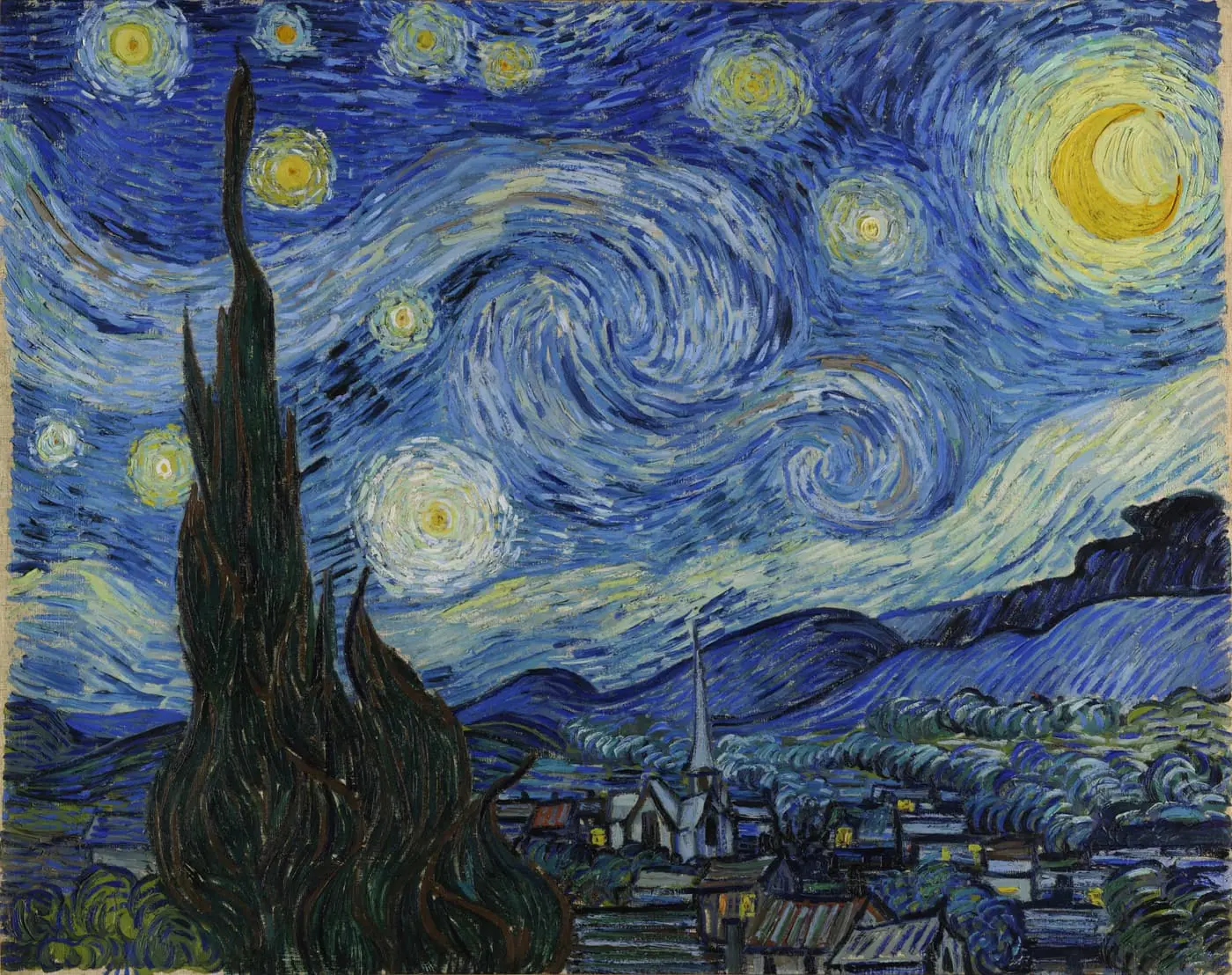
The Starry Night
Vincent van Gogh · 1853–1890
3 variations + a matched story print, every standard frame ratio. sRGB · up to 300 DPI · personal-use license.
Print it your way — at home, a local shop, or a gallery print delivered to your door. See the printing guide →
Sizes in the download
Print-ready files at every standard frame ratio below — the full image, nothing cropped:
The print is crisp at 300 DPI up to about 30×40″, and stays sharp at 150 DPI from across the room, out to about 40×60″.
[ Will it fit your frame? ]
The work
A sky that turns before you read a star.
A scatter of stars and a low crescent burn through a sky that will not hold still. Run your eye along the surface and you see why: the village below is laid in short, stabbing strokes, while the heaven above is dragged into long twisting ropes of paint, a double spiral coiling at the centre. The cypress on the left climbs like dark green flame, taller than the church, joining earth to sky. Nothing here sits quietly to be looked at. The picture moves first, and the named things — house, steeple, star — arrive a moment later, once your eye has caught up.
Look closer
Not the view from his window, but a sky composed.
Van Gogh painted this in June 1889 inside the Saint-Paul asylum at Saint-Rémy — by daylight, in his ground-floor studio, not at the window after dark (the hospital did not let him paint in his bedroom). He had watched the dawn sky from that room — the morning star "looked very big," he wrote — and scholars have matched real stars to the canvas. But the sleeping village below was never visible from his cell, and the slim spire piercing it is more Dutch than Provençal, a church recalled from his boyhood in the North (a reading Ronald Pickvance drew from Van Gogh's earlier Nuenen drawings). The cypress, often read as a tree of death and mourning, is counted by some scholars among that same invention. He composed the most famous night in art — part seen, part imagined — far more deliberately than the legend of a frenzied night allows.
On a wall
The picture everyone already loves, at full scale.
This is the night sky the whole world knows, and it earns the size: our master holds a true 24×36 at 300 DPI with room to spare, so the swelling stars and the long ropes of the sky stay crisp on a large wall. The native proportions are a gentle landscape, near five-to-four — square, 4:3, 5:4 and A-series all sit cleanly within the painting's own edges. It hangs warm against deep blue, a calm that the surface keeps quietly contradicting. The original lives at the Museum of Modern Art in New York; this is your own print of it, ready in minutes, for the price of a sandwich.
This morning I saw the countryside from my window a long time before sunrise with nothing but the morning star, which looked very big.— Vincent van Gogh to his brother Theo, Saint-Rémy, late May 1889
The file & the facts
- Title
- The Starry Night
- Artist
- Vincent van Gogh
- Year
- 1889
- Medium
- Oil on canvas
- Original
- 73.7 × 92.1 cm
- Collection
- The Museum of Modern Art, New York
- Rights
- Public-domain painting · faithful reproduction (PD-Art) · The Museum of Modern Art, New York — acquired through the Lillie P. Bliss Bequest (by exchange), 472.1941. Digital image: Google Art Project via Wikimedia Commons (public domain)
- File
- sRGB · JPEG · 150–300 DPI


