The archive / Natural History / Zebra
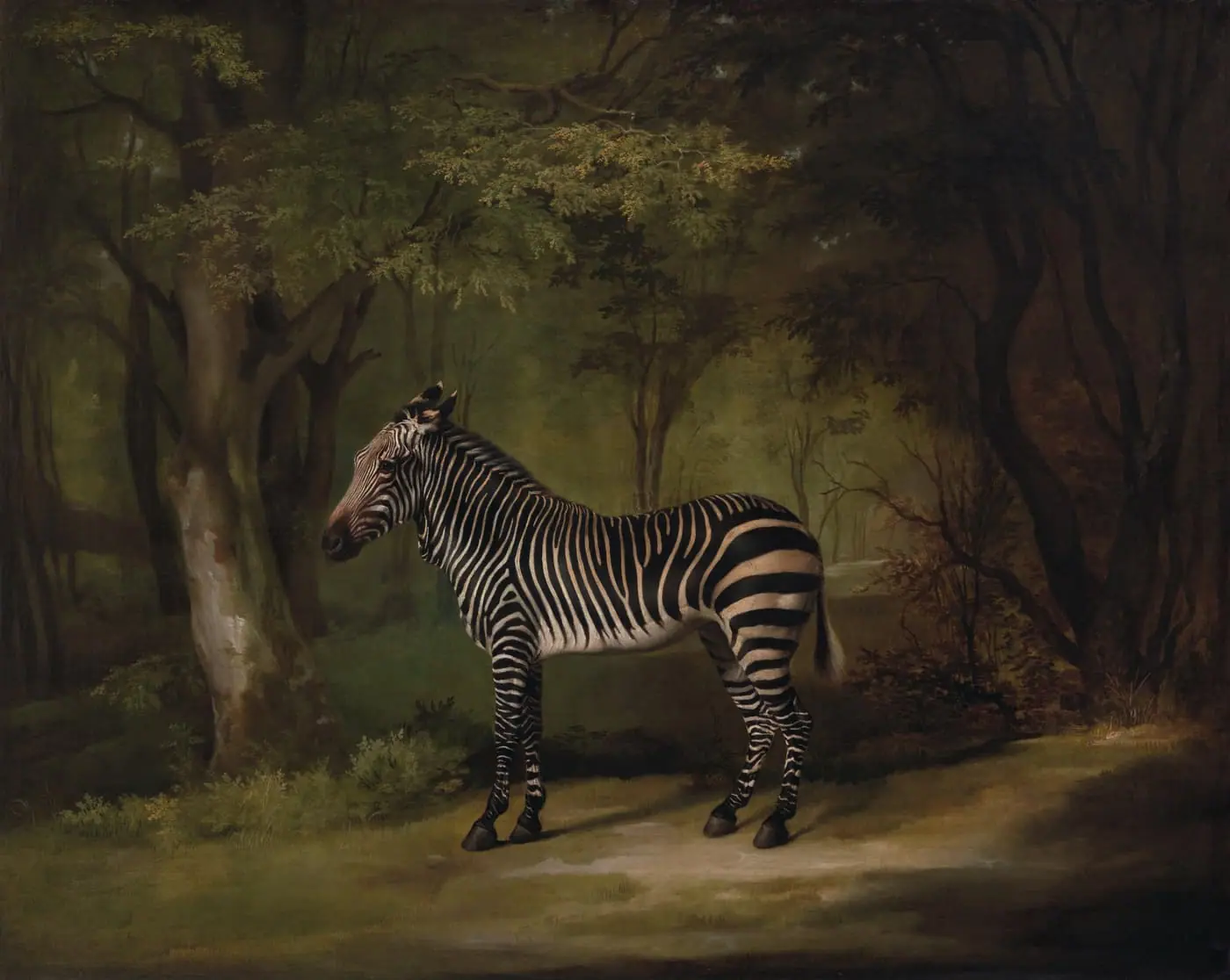
Zebra
George Stubbs · British, 1724–1806
Coming soon. Be first to know when it’s ready.
Emails sent via Kit · Privacy
3 variations + a matched story print, every standard frame ratio. sRGB · up to 300 DPI · personal-use license.
Print it your way — at home, a local shop, or a gallery print delivered to your door. See the printing guide →
Sizes in the download
Print-ready files at every standard frame ratio below — the full image, nothing cropped:
The print is crisp at 300 DPI up to about 24×36″, and stays sharp at 150 DPI from across the room, out to about 40×60″.
[ Will it fit your frame? ]
THE WORK
A specimen, posed for the record.
She holds an exact side-on profile, all four legs in view, the stripes legible from nose to tail. This is the pose of a scientific plate, the convention for showing a new animal whole, and Stubbs gives it to you cleanly. The ears tell the rest: laid back and alert rather than at ease, the small tension of a wild creature that has not settled. He studied her from the living animal — access arranged by William Hunter, the queen's physician, who held a post in her household and could get a friend through the menagerie gate. What he could verify, he set down precisely.
WHERE SHE CAME FROM
A wedding gift, and a public sensation.
This was a real, named event, not a fancy. A female Cape mountain zebra reached London in 1762 aboard a Royal Navy ship from the Cape of Good Hope, a belated wedding gift to the young Queen Charlotte. She was installed in a paddock by Buckingham House and besieged: one observer said she had "all her hours employed from morning to night in satisfying the curiosity of the public." The crowds nicknamed her "the Queen's Ass" and printed bawdy songs about her. She was the first zebra most Britons had a chance to see — though an earlier one had been kept at Kew in the 1740s, so the safer claim is the first widely exhibited, not the first to set hoof in the country.
LOOK CLOSER
The forest is pure invention.
Then look past her, into the trees, and the document turns to fiction. The setting is a dark, leafy English wood, dense and tapestry-like, the kind of bosky thicket no Cape zebra ever stood in. Stubbs invented all of it; the living animal he drew from never left a royal paddock for any wood. That single mismatch is what makes the picture hold the eye — an African animal dropped into a Northern forest, exact science framed by pure imagination. Half natural-history plate, half enchanted wood, and the seam between them never quite closes.
"The Queen's she-ass … had all her hours employed from morning to night in satisfying the curiosity of the public."an unidentified contemporary observer
The file & the facts
- Title
- Zebra
- Artist
- George Stubbs
- Year
- 1763
- Medium
- Oil on canvas
- Original
- 102.9 × 127.6 cm
- Collection
- Yale Center for British Art
- Rights
- Public-domain painting · open access · Yale Center for British Art, Paul Mellon Collection, B1981.25.617 (CC0, courtesy)
- File
- sRGB · JPEG · 150–300 DPI