The archive / Pahari Painting / Adoration of Young Krishna
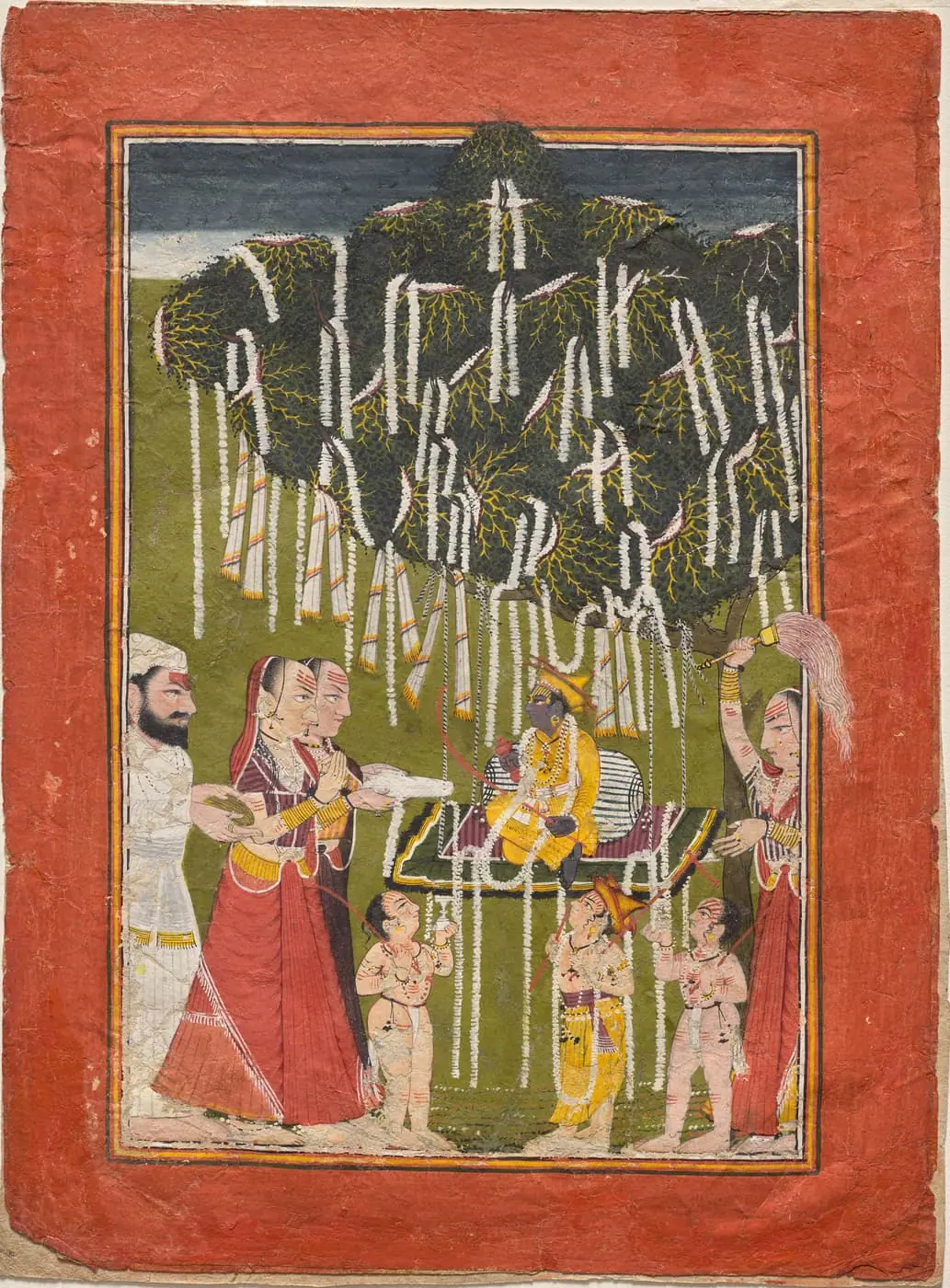
Adoration of Young Krishna
Unknown, Pahari · Pahari school, Punjab Hills, North India
Coming soon. Be first to know when it’s ready.
Emails sent via Kit · Privacy
3 variations + a matched story print, every standard frame ratio. sRGB · up to 300 DPI · personal-use license.
Print it your way — at home, a local shop, or a gallery print delivered to your door. See the printing guide →
Sizes in the download
Print-ready files at every standard frame ratio below — the full image, nothing cropped:
The print is crisp at 300 DPI up to about 24×36″, and stays sharp at 150 DPI from across the room, out to about 40×60″.
[ Will it fit your frame? ]
THE WORK
The god you picture as a distant blue king, here a baby with a rattle.
He is blue-skinned, as Krishna always is, but everything else resets the scale. He is an infant, a toy rattle in his fist, and a crowd has gathered under a pipal tree to adore him. Note one off-key detail: instead of the wrapped dhoti a Hindu god usually wears, this child is dressed in a yellow jama, the belted Central Asian tunic of the Mughal court. The painter has put the child-god of Vaishnava devotion into contemporary court dress and set a tree, hung with garlands and scarves, behind him for a shrine. The result is intimate rather than imperial. You are not looking up at a remote deity; you are gathered in close around a small one.
LOOK CLOSER
Read the foreheads, and the devotion crosses a line it shouldn't.
The worshippers wear horizontal marks on their brows, which identify them as Shaivites — followers of Shiva, not of Vishnu, whom this infant Krishna embodies. They have come anyway, holding out cloth offerings to a child from the rival side of the faith, and the tree above them is dressed with garlands and scarves to draw down auspicious, divine benevolence. That is the picture's quiet argument and the heart of bhakti, the religion of personal love for the divine that the hill painters made their subject: feeling for the god outruns the boundaries of sect. The Bhagavata Purana, the great Krishna text these courts loved to illustrate, is the larger world this devotion belongs to — the remote cosmos drawn near in the form of a child.
PAHARI KINGDOMS, c. 1720–25
No shadow, no modelling — the line does all the work.
Trace any figure and you find a single confident contour carrying the whole form, set against flat planes of saturated colour with no European-style shading inside them. This is the early flowering of Pahari painting in the Punjab hill courts, where hereditary workshops gave Hindu gods a fresh, emotionally charged look. It is the opposite method to a Rembrandt: not light dragged across a modelled body, but pure line and unbroken colour. The hand is unrecorded — these painters worked in family ateliers and rarely signed, and scholars have never securely fixed which hill court produced it. Calling it simply Pahari is the honest answer. The anonymity measures how the work was made, not how good it is.
Pahari court painters devised fresh iconography to depict the Hindu gods within emotionally charged episodes from religious texts, encouraging the viewer to experience a personal and even passionate connection with the divine, an experience called bhakti.Louise Nicholson, Apollo, 2019
The file & the facts
- Title
- Adoration of Young Krishna
- Artist
- Unknown, Pahari
- Year
- c. 1720–25
- Medium
- Gum tempera on paper
- Original
- Image 23.6 × 16.6 cm (page 29.2 × 21.6 cm)
- Collection
- The Cleveland Museum of Art
- Rights
- Public-domain painting · open access · The Cleveland Museum of Art, 2018.97 (CC0, courtesy)
- File
- sRGB · JPEG · 150–300 DPI