The archive / Expressionism / Seated Male Nude (Self-Portrait)
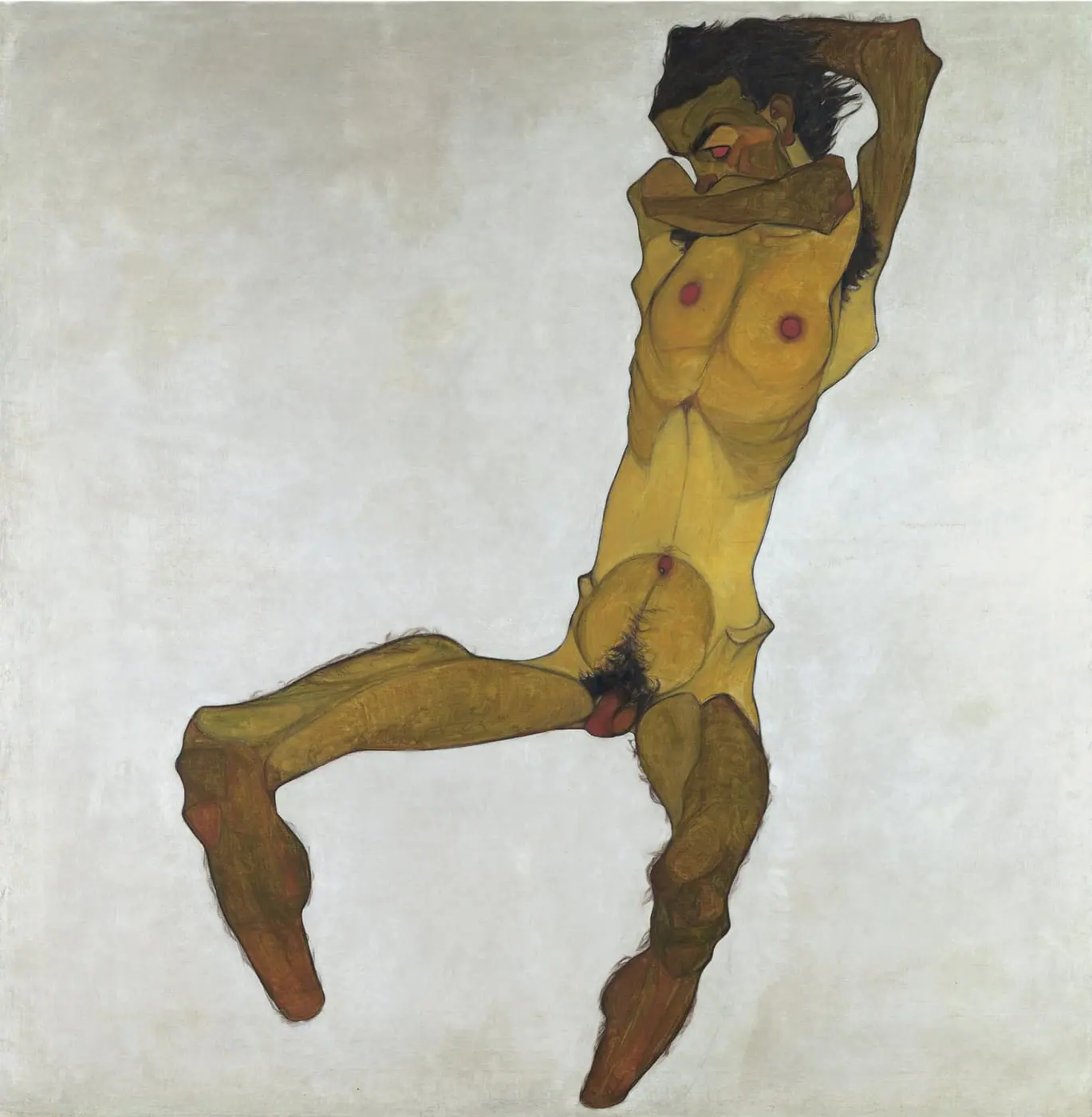
Seated Male Nude (Self-Portrait)
Egon Schiele · 1890–1918
3 variations + a matched story print, every standard frame ratio. sRGB · up to 300 DPI · personal-use license.
Print it your way — at home, a local shop, or a gallery print delivered to your door. See the printing guide →
Sizes in the download
Print-ready files at every standard frame ratio below — the full image, nothing cropped:
The print is crisp at 300 DPI up to about 16×16″, and stays sharp at 150 DPI from across the room, out to about 30×30″.
[ Will it fit your frame? ]
THE WORK
A body called “seated,” with nothing under it to sit on.
A naked man hangs in an empty field of white. There is no chair beneath him, no floor, no wall, no horizon — nothing for the title’s word, seated, to rest on. One arm is clamped over the head and the shoulder wrenched from its socket; the hands and feet darken into stumps, as if the canvas were cropping the body away at the wrists and ankles. Schiele painted it in 1910, at twenty, in oil and opaque colour, a near-square roughly five feet on a side. The contortion is not accident or anguish leaking onto the canvas. It is a deliberate program — the body posed, lit and broken on purpose, not the symptom of a troubled mind.
LOOK CLOSER
Red where an anatomist would set the pins.
The flesh is a sick yellow-green, modelled so that every tendon, muscle and bone reads through the skin — the Leopold Museum calls it a body made to look almost skinned. Then come the marks that fix you: the eyes, the nipples, the navel and the genitals are pricked out in a hot signal red, like an anatomist’s pins planted in a flayed specimen. The red does the pointing the missing background won’t. With no room around him, no shadow under him, the figure can only levitate, and the eye is driven straight to those few red points on the hovering body. It is the most exposed a painted nude can be: skin opened, organs flagged, nowhere to stand.
VIENNA, 1910
Klimt’s gold, scraped down to sinew.
Schiele came up in Klimt’s Vienna — the older man spotted him early, traded drawings with him, opened doors. They are bound together at the end, too: both gone in 1918, within months of each other, Klimt in February and Schiele that October at twenty-eight. This canvas carries the title Self-Portrait, and the museum still presents it that way. Yet look at it again and the certainty thins: the face is barely there, and these 1910 male nudes — Schiele’s so-called Red Men — are now contested ground. Jane Kallir, who keeps his catalogue raisonné, argues they are not self-portraits at all but portraits of others — the faces left blank, she suggests, to conceal the identities of friends such as Erwin Osen and Max Oppenheimer at a time when homosexuality was illegal in Vienna. We may be looking not at Schiele, but at a body stripped so bare of identity that no one is sure whose it is — which is the most unsettling thing about it.
…the body finds no support in the thinly applied monochrome white of the background – it levitates in the placeless pictorial space…— Leopold Museum, on Seated Male Nude
The file & the facts
- Title
- Seated Male Nude (Self-Portrait)
- Artist
- Egon Schiele
- Year
- 1910
- Medium
- Oil & opaque colour on canvas
- Original
- 152.5 × 150 cm
- Collection
- Leopold Museum, Vienna
- Rights
- Public-domain painting · open access · Leopold Museum, Vienna (Inv. 465) / Google Art Project — courtesy
- File
- sRGB · JPEG · 150–300 DPI


_-_Google_Art_Project.jpg)