The archive / Rococo / Madame Grand
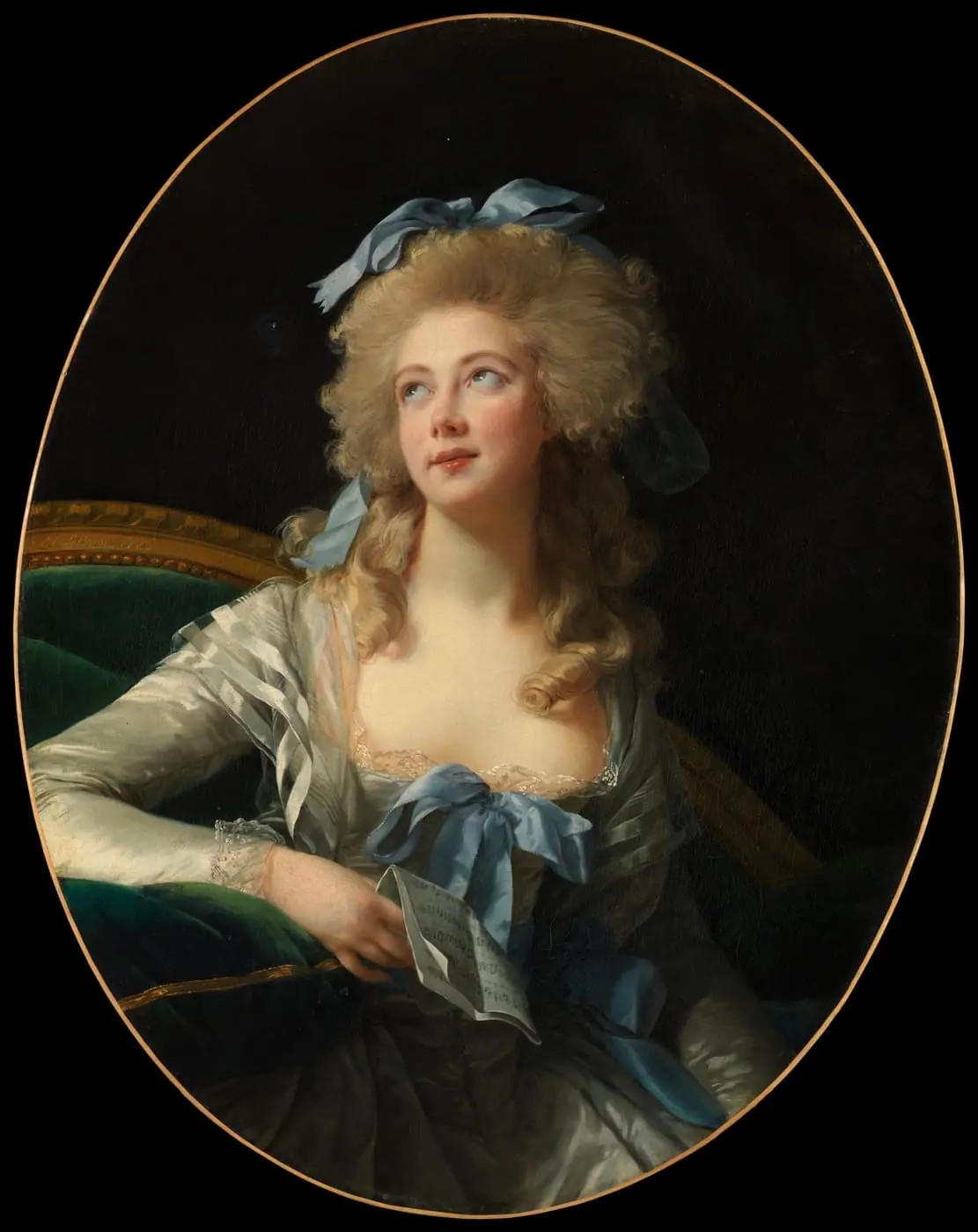
Madame Grand
Élisabeth Louise Vigée Le Brun · 1755–1842
3 variations + a matched story print, every standard frame ratio. sRGB · up to 300 DPI · personal-use license.
Print it your way — at home, a local shop, or a gallery print delivered to your door. See the printing guide →
Sizes in the download
Print-ready files at every standard frame ratio below — the full image, nothing cropped:
Every size here is print-ready, sharp at viewing distance. Up close, the print is crispest at 300 DPI up to about A4; at larger sizes the cream mat carries the print to the frame while the painting sits at its sharpest within.
[ Will it fit your frame? ]
THE WORK
A young woman caught on a held note.
She has turned her face up and to the side, lips just parted, eyes rolled toward the light, a sheet of music loose in one hand. The skin is painted with the soft, powdery finish that made Vigée Le Brun the most sought-after portraitist of her day: no hard edges, the blush blended up into the cheek, the blonde curls dissolving into the warm ground. It is an oval, almost a metre tall, and the curve of the frame answers the curve of her bare shoulder and throat. The Met reads the upward gaze as an imitation of Saint Cecilia, patron saint of music — the pose and especially the eyes long compared to Domenichino's Saint Cecilia (1617–18, Louvre) — the sitter caught not posing but mid-song.
TWO LIVES
The toast of Paris at twenty-one; a princess past forty.
The sitter is Catherine Worlée, born in colonial India in 1761 and married off at fifteen. By the time she sat for this, around twenty-one, she was the most talked-about woman in Paris, exoticised by admirers under the epithet l'Indienne. A lazy legend has come down with her — beautiful, the story goes, but stupid. It is a slander: contemporaries described her as a beautiful blonde, musical and clever, and the Met records the same. The picture marks a beginning, not a peak. Two decades later she married Talleyrand, the most powerful diplomat in Europe; when Napoleon made him Prince of Benevento in 1806, she became a princess. The face here is twenty-one and rising.
THE WOMAN MASTER
Painted the year its maker was let into a room built to keep her out.
1783 is the year Vigée Le Brun was admitted to France's Royal Academy — and this portrait hung at her Salon that same season. Admission did not come easily. She was first refused on a technicality, that her husband was an art dealer, and the door opened only when Louis XVI overruled the Academy under pressure from Marie Antoinette, her patron. She entered as one of just four women the institution would hold. The barrier, as Linda Nochlin later argued of every such case, was never the talent. It was the institution — and a portrait like this, sized and finished to compete with anyone's, was the argument she made on canvas.
This remarkable image of her with eyes raised and lips parted as if in song was among ten portraits and three history paintings shown by Vigée Le Brun at the Salon of 1783, the same year the artist was accepted as one of only four female members of the French Royal Academy.— The Metropolitan Museum of Art, on Madame Grand
The file & the facts
- Title
- Madame Grand
- Artist
- Élisabeth Louise Vigée Le Brun
- Year
- 1783
- Medium
- Oil on canvas
- Original
- Oval, 92.1 × 72.4 cm
- Collection
- The Metropolitan Museum of Art
- Rights
- Public-domain painting · open access · The Metropolitan Museum of Art — Bequest of Edward S. Harkness, 1940 (50.135.2, CC0, courtesy)
- File
- sRGB · JPEG · 150–300 DPI


