The archive / Chinese painting / Road to Shu
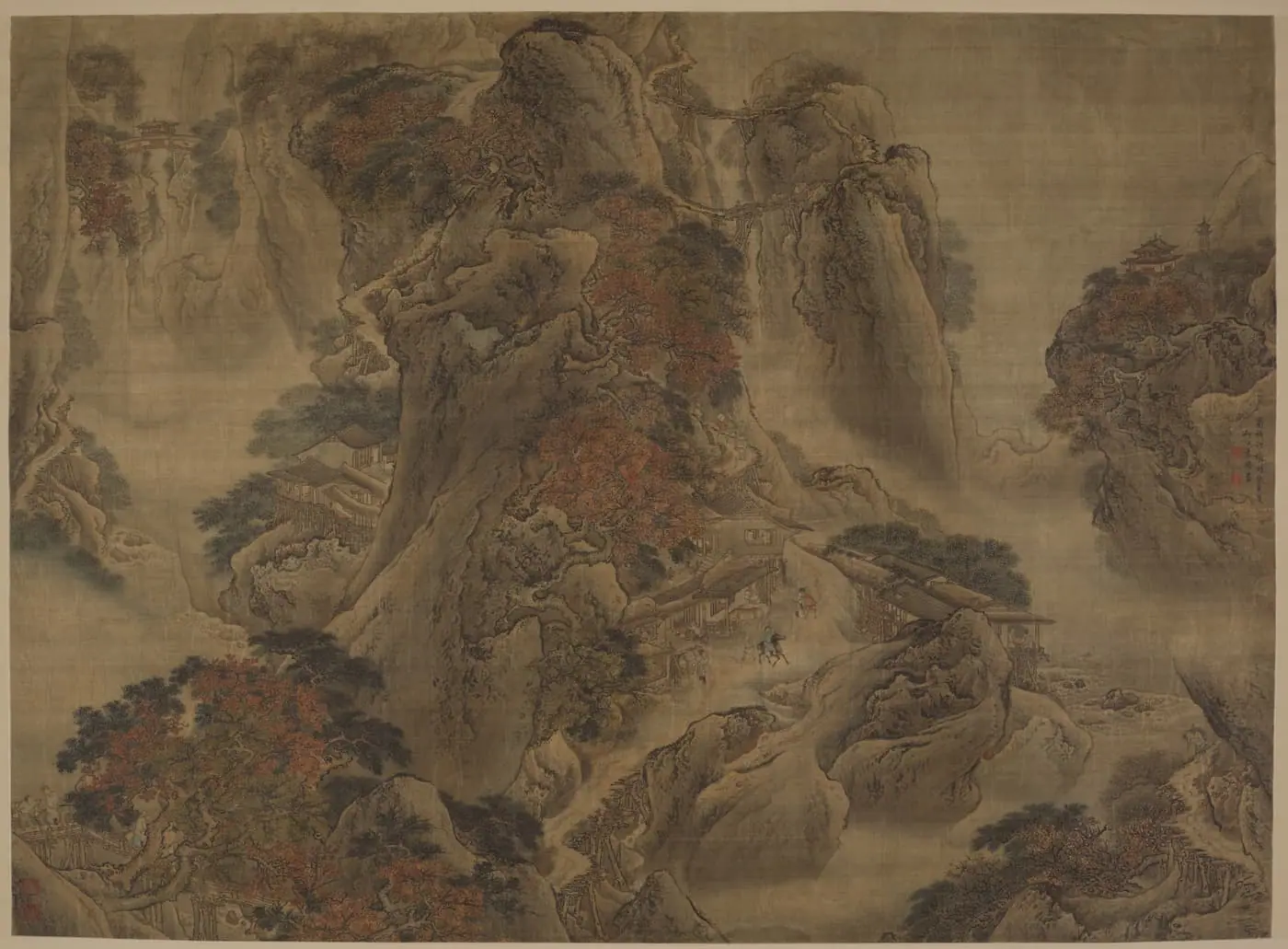
Road to Shu
Yuan Yao · active mid-1700s
3 variations + a matched story print, every standard frame ratio. sRGB · up to 300 DPI · personal-use license.
Print it your way — at home, a local shop, or a gallery print delivered to your door. See the printing guide →
Sizes in the download
Print-ready files at every standard frame ratio below — the full image, nothing cropped:
The print is crisp at 300 DPI up to about 30×40″, and stays sharp at 150 DPI from across the room, out to about 40×60″.
[ Will it fit your frame? ]
THE WORK
A wall of mist-mountains, eight feet wide, that makes you look up.
On a sheet of silk over eight feet wide and six feet tall, peaks pile on peaks, muted ink washed grey-green and flecked with the red of autumn maples. Mist does the work of glue, dissolving the joins so one rock face seems to grow out of the cloud below it. The eye does not take this in at a glance; it has to climb, switchback by switchback, the way the road does. And the higher you go, the smaller everything gets — from monumental cliff at the bottom to, near the top, figures you could miss entirely. The scale telescopes on purpose. You are meant to feel the height in your feet.
LOOK CLOSER
Find the travelers — and notice the cliffs were drawn with rulers.
Down in the gorge, hunt for them: tiny travelers leading pack-horses over plank roads — timber walkways pinned to the sheer rock — and a clutch of figures resting at a mountain inn. They are the reward for looking, no bigger than a thumbnail against the stone. Now notice the architecture itself. The pavilions, the bridges, the cantilevered spans are too crisp, too plumb to be freehand, and they are not. This is jiehua, “ruled-line” painting: a Chinese genre in which structures are drawn with rulers and exact measure, prized for faultless geometry. Yuan Yao keeps every beam true while the mountains around them stay loose and wet.
YANGZHOU, 1743
Built to stun the man who paid for it.
This is not a scholar’s private landscape but a decorative blockbuster, made in Yangzhou — a Qing salt-merchant boom city — to hang on a rich patron’s wall and overwhelm him. Yuan Yao trained under the older master Yuan Jiang and ran in his studio’s commercial, virtuoso line. The subject carries weight too: the Shu plank roads are the perilous route into Sichuan, and the title summons the flight of the Tang emperor Xuanzong there, after the An Lushan Rebellion broke out in 755 and tore the dynasty open. It belongs to a long tradition that called the road to Shu hard. Painted to sell, and to stun — the show-stopping face of Chinese landscape.
Busy travelers lead mules over footbridges, mountain paths wind along steep slopes, and soaring bridges connect peaks divided by deep gorges.— The Cleveland Museum of Art, on Road to Shu
The file & the facts
- Title
- Road to Shu
- Artist
- Yuan Yao
- Year
- 1743
- Medium
- Ink & colour on silk
- Original
- 187 × 256.5 cm
- Collection
- The Cleveland Museum of Art
- Rights
- Public-domain painting · open access · The Cleveland Museum of Art — John L. Severance Fund, 2019.167 (CC0, courtesy)
- File
- sRGB · JPEG · 150–300 DPI


