The Case for Sacred Art in a Secular Room
Hang a Tibetan thangka in a hallway and, sooner or later, someone will stand in front of it and ask — carefully — not whether they like it but whether you're allowed to do that. They're not Buddhist; very likely neither are you. The goddess in the painting was made to be prayed to. And there she is over the radiator, between the coat hooks and a print of a harbour.
It is a fair question, and most people who own a piece of sacred art have felt some version of it. We hang a Botticelli Venus without a flicker of doubt and then go quiet in front of a Madonna or a Tara, sensing, rightly, that something here is not just a picture. This essay is an argument that you can hang it, and a careful account of what that costs and what it asks. The short version: the honest way to live with a holy image you don't worship is not to avoid it and not to style it, but to look at it hard enough to know what it is. Attention is the closest thing to reverence a non-believer has to offer, and most of these objects were built, in the first place, to receive exactly that.
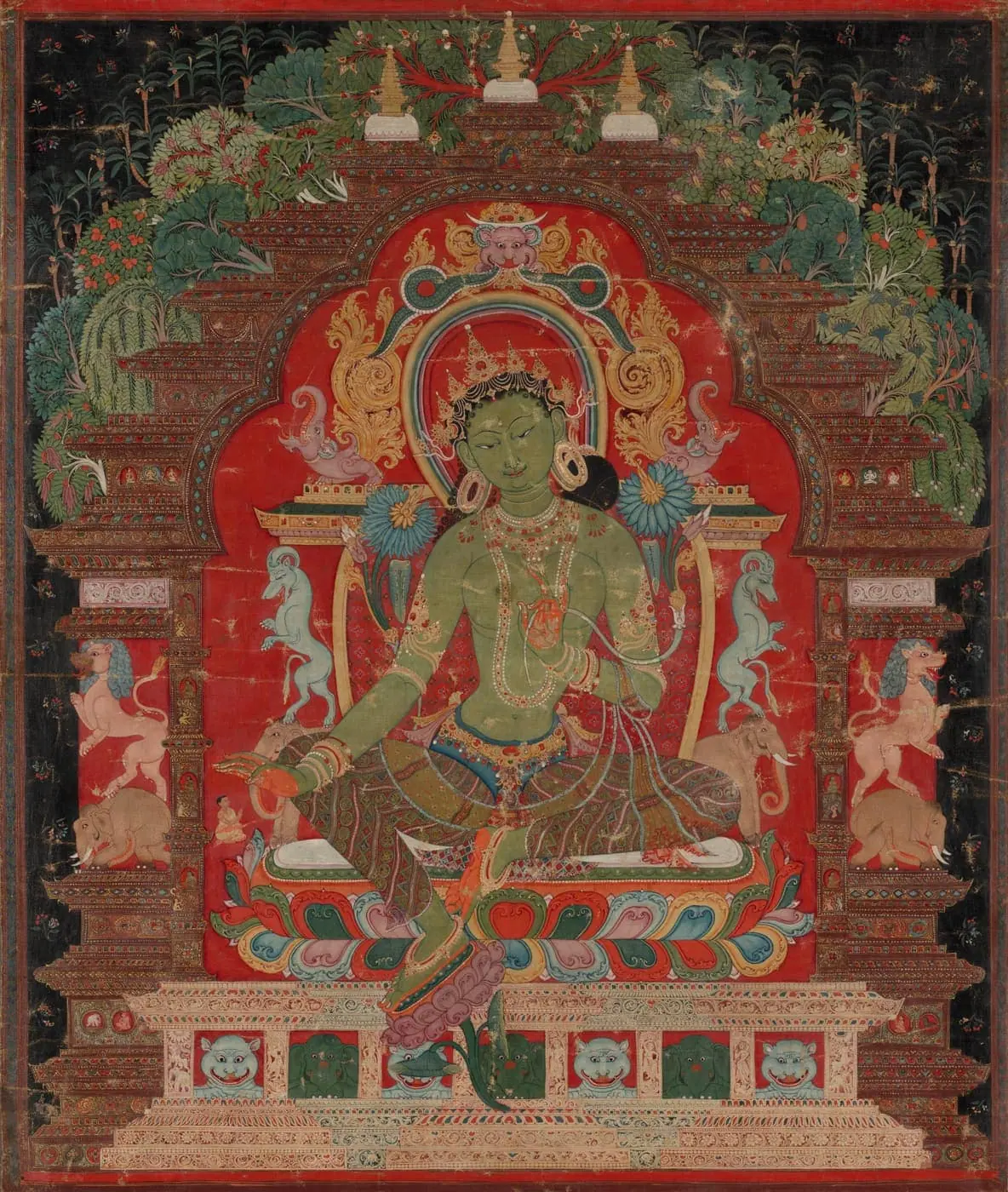
These objects were made for rooms, not vitrines
Start with the most useful fact, because it dissolves half the unease on its own: most sacred art was never made for a museum. It was made to be used — at an altar, a shrine, in the hand — and to do a job there.
Our Green Tara is the clearest case in the catalog. It is a thangka, a Tibetan devotional painting on cloth, and the giveaway is on the side you never see. Tara's mantra is written on the back of the panel, in ink, where no viewer can read it. You don't inscribe the reverse of a picture you intend to frame and admire. You inscribe the reverse of a tool: an object built to be rolled up, carried, unrolled at a shrine, prayed in front of, rolled again. Look at the figure and the working logic is right there in her body. She sits in the posture of royal ease, but her right leg hangs down off the lotus throne, not resting, poised, caught the instant before she rises. In Tibetan Buddhism she has a specific assignment: she dispels fear and gives protection, and the lowered foot says she is ready to step into the world and do it. Her right hand turns palm-out, the fear-not gesture. This was never a museum object that someone, regrettably, has now domesticated. It was made for use, not for a vitrine — to be carried, unrolled, prayed in front of. An object built for devotion, not for detached display, already knew how to live with people.
Hold that against the museum habit we have all absorbed: the rope, the glass, the hush, the wall text telling you when to be impressed. That apparatus is barely two centuries old, and it teaches a single posture toward every image: stand back, do not touch, regard. For a great deal of the art it houses, that posture is a mistranslation. A thangka behind glass is a hammer in a vitrine. Bringing one home and hanging it where you actually pass it forty times a day is, in one narrow respect, closer to its original life than a museum vitrine is.
The real objection, said plainly
So far this is easy, and I distrust easy. There is a genuine difference the argument has to face, and waving it off is exactly the glibness this subject earns scorn for.
The difference is aliveness. A 500-year-old European altarpiece, once it lands in a museum, has been aestheticized by time and disuse; few who pass it there kneel, and hanging a fragment of one reads to almost no one as a theological act. But Green Tara is venerated today, by living people, in living practice. The Ethiopian icon tradition is not a closed chapter; it is a working faith with working images. Our Lady of Valvanera is a Catholic devotional picture, and Catholicism is, last I checked, a going concern. To pretend these are all just "old art" is to flatten a living tradition into a mood board, which is precisely the appropriation-as-vibe that makes thoughtful people uneasy. Hanging a working deity you do not worship is not nothing. Anyone who tells you it is hasn't thought about it.
I want to grant that fully, and then make the case anyway. Refusing to hang a Tara because you're "not entitled to it" can be a way of keeping the encounter at arm's length, of never doing the work of learning what she is, and a tradition is not honoured by being treated as radioactive. The styling impulse, on the other end, treats the image as pure surface: a hit of gold, an exotic face, a vibe in a frame, the meaning sanded off because it is inconvenient. Both responses, oddly, decline to look: one looks away out of nerves, the other looks only at the colour. The third option is harder and more honest: hang it, and then learn what you've hung. Let the thing mean what it means in your house instead of asking it to mean nothing, or to mean only "pretty." That is not worship; you don't owe it worship. But it is the opposite of using it as a prop.
The line I'd defend is this: context plus attention is respect; extraction plus ignorance is appropriation.
The gold is the argument, not the decor
Consider the piece that most tempts the styling reflex, and watch how attention changes what you're doing with it.
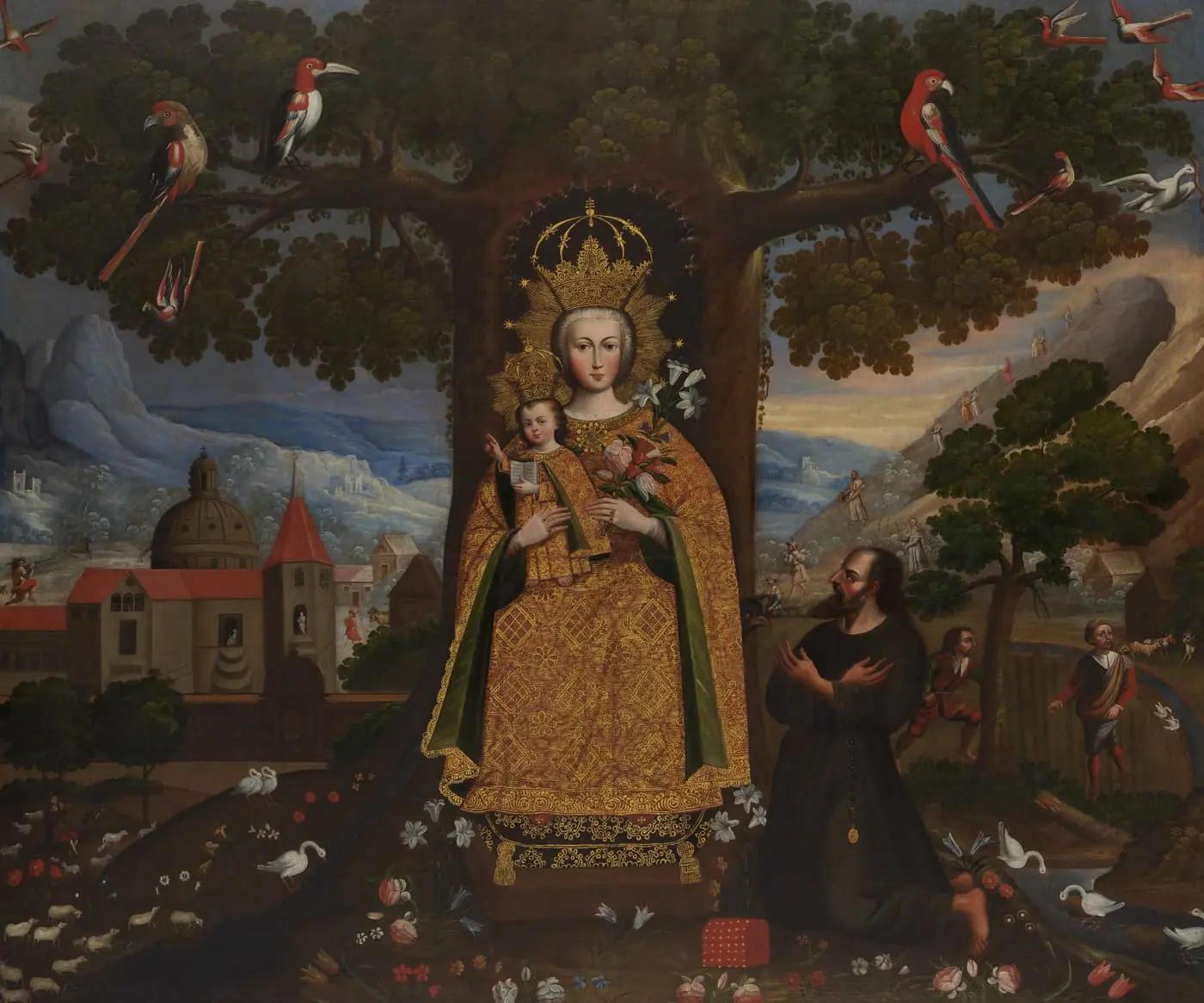
Our Lady of Valvanera reads across a room like a Klimt, frontal, crowned, the robes blazing, and it would be the easiest thing in the world to hang it for the shine and stop there. But the shine is not a decorative choice; it is real gold leaf, laid over the painted robes and tooled into pattern, a technique called brocateado. And it is doing theology. In the Andes, miraculous Virgins were honoured as carved wooden statues dressed in stiff, gold-threaded gowns and paraded in their finery. The gold on this flat canvas is reaching for that: paint standing in for a dressed cult image, ornament doing the work belief assigns it. The picture was made around 1770 by an anonymous workshop of the Cuzco School, the Indigenous painters who had walked out of the Spanish-run painters' guild in 1688 and built a tradition of their own, where authorship belonged to the shop, not the signature. So this is a borrowed Spanish saint remade in Andean terms by Andean hands: a colonial Catholic image that an Indigenous workshop took and made theirs.
Now: you can hang that for the gold. Or you can hang it knowing all of the above, in which case the gold stops being a colour and becomes the most interesting thing in the room: a 250-year-old argument about how to make a flat painting carry the presence of a dressed statue, made by people in a tradition where the work belonged to the shop, not the signature, and whose individual names simply did not come down to us. The picture is identical on the wall. What's different is whether you're looking.
Looking back is the point
Some of these works don't merely reward attention. They demand it, structurally; they were engineered to hold your gaze, and on a secular wall that engineering still fires.
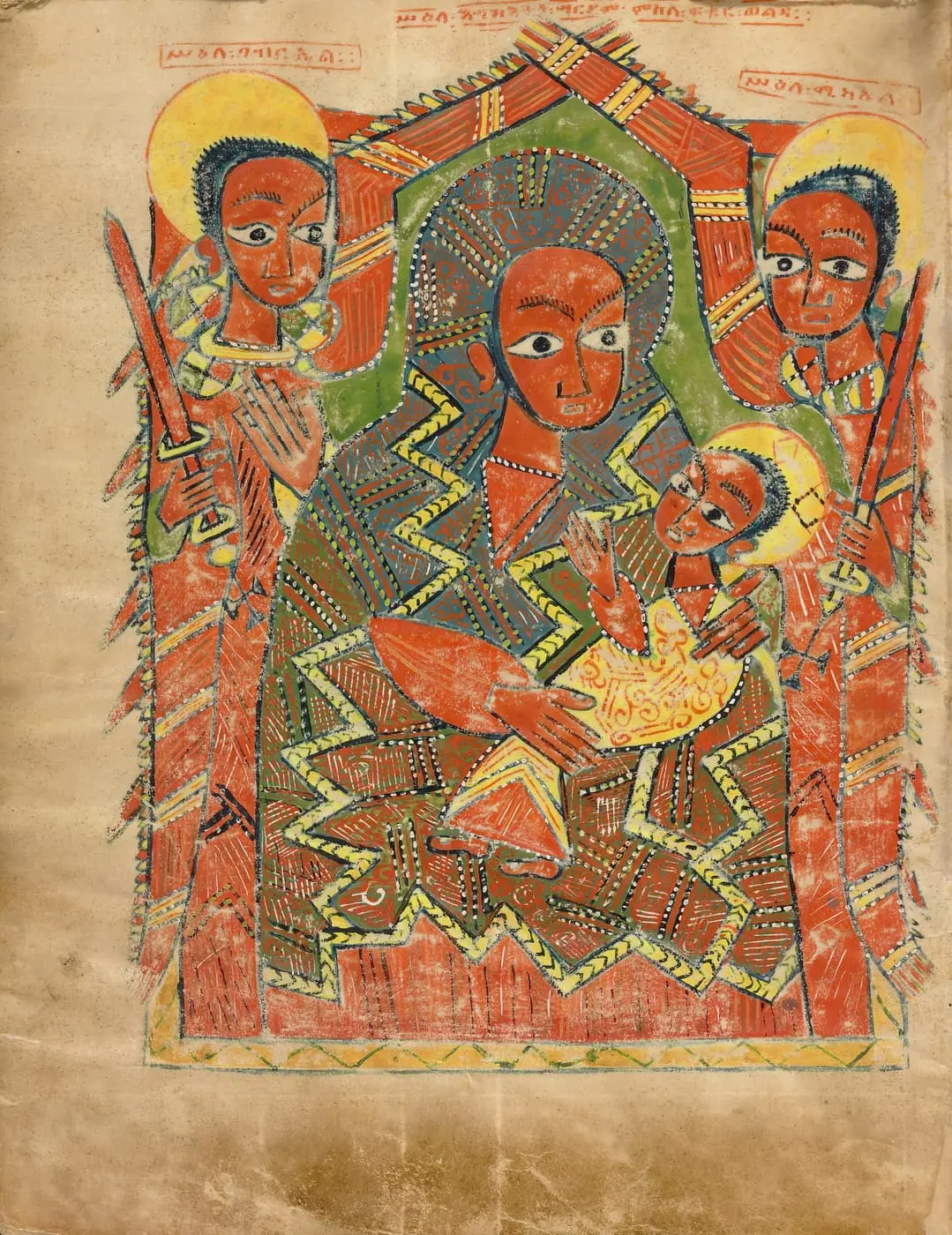
Look at The Virgin and Child with the Archangels and the eyes find you before anything else does. They are outlined in heavy dark ink and opened far wider than any real face would allow, and that is not clumsy drawing; it's the engine of the whole image. This is a single illuminated leaf from a Gospel book made in the Ethiopian highlands around 1504, in the style of the Gunda Gunde monastery: the immense almond eyes, the saturated flat colour, the dotted borders, the text in Ge'ez. A European illuminator of the same decade would have built the Virgin out of light and shadow. This painter refuses modelling entirely and builds her from pattern instead, then lets the eyes and the gold carry the holiness. The wide gaze is a contact point, the place where the viewer and the holy were meant to meet. A devotional image, in this tradition, is something you turn to, and it looks back.
Here's what's strange and worth sitting with. That gaze doesn't switch off because you're not Orthodox. The eyes still meet yours across a room; the picture still treats you as someone it has something to say to. You are not faking anything by letting an image built for contact make contact. That exchange is available to attention alone. The page was made to be looked in the eye, and you can do that honestly, on a secular wall, without belief.
The tell: our squeamishness is selective
Here is the proof that the discomfort is about familiarity, not principle. We hang one kind of sacred image without a second thought.
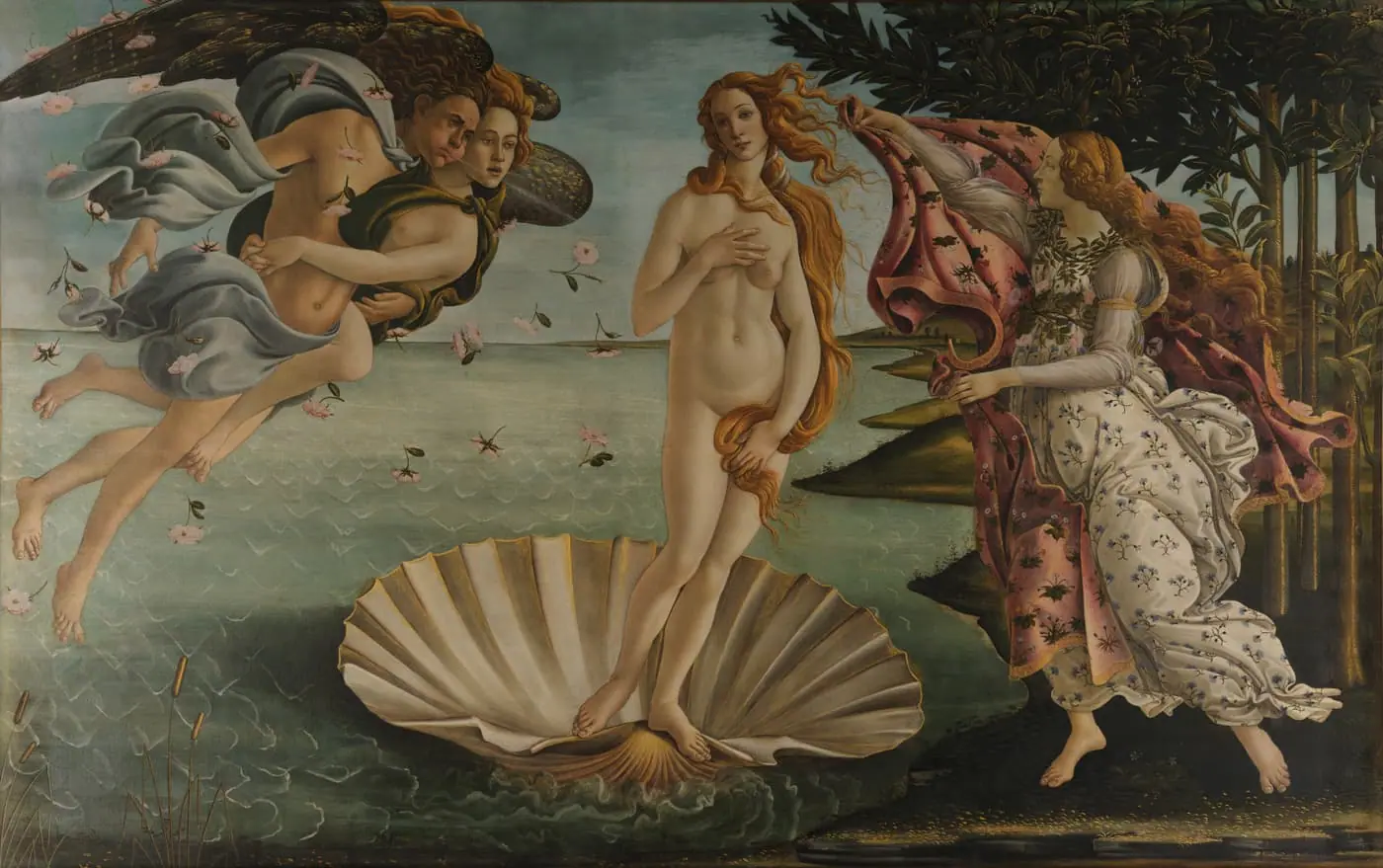
The Birth of Venus can be read as a pagan-sacred image. It is a goddess, an actual deity of an actual religion, arriving on her scallop shell as the embodiment of divine love and beauty. Botticelli painted her around 1485 not for an altar but for a Medici villa wall, by a culture that no longer sacrificed to the antique gods but took them seriously as ideas worth living by. She was never a cult object the way a thangka is — but hold her in that light and the kinship is real. And nobody, anywhere, hesitates to hang her. She is on tote bags and shower curtains. The squeamishness that descends in front of Green Tara evaporates completely in front of Venus, and the only thing that changed is that almost no one around you worships Venus. Her cult is, for practical purposes, a closed book — a handful of modern polytheists aside — so her divinity has cooled into "art," and we hang the goddess without noticing she's a goddess at all.
That's the tell. Our hesitation isn't really a principle about sacred images. It's a discomfort about living faiths, dressed up as one. The honest position isn't "treat everything like a museum-safe Venus." It's the reverse: treat the Venus a little more like a Tara. Remember that she, too, meant something, to someone, as a sacred thing. The attention you'd give a working deity is the attention every one of these images deserves; we've just forgotten to pay it to the ones we find easy.
What Klimt borrowed, and what he left behind
One more picture, because it draws the boundary of the whole argument exactly.
When Klimt covered The Kiss in gold leaf, he was not inventing. In 1903 he had travelled to Ravenna and stood in front of the sixth-century Byzantine mosaics of San Vitale, the gold-ground glitter of the Emperor Justinian and the Empress Theodora, and he never got over it. In Byzantine art, the gold ground was not decoration. It signified an eternal realm beyond time, a field of divine light in which the holy figures floated free of the ordinary world. Klimt took that exact device, the flat blaze of sacred gold, and wrapped it around two lovers. The form draws directly on the gold ground of Byzantine sacred art. The function is gone. His gold doesn't open onto eternity; it makes a beautiful surface for an embrace. He kept the sacred technique and drained out the sacred content, which is its own legitimate, knowing move, worlds away from doing it by accident.
That's the line, finally, drawn in gold leaf. Klimt borrowed sacred form with his eyes open, and the result is honest because he knew exactly what he was taking and what he was leaving. The dishonest version of living with sacred art is borrowing blind: taking Tara's gold and Valvanera's gold and the icon's gaze for the look of them, without the faintest idea that they ever meant anything. The remedy is not to put the holy pictures back behind glass. It is to do what Klimt did and what the museum can't make you do: know what the thing is. Then hang it.
So, can you hang it?
Yes. Hang it with attention, the form of reverence a non-believer can honestly offer, because attention is what they were built to receive.
Know that the mantra is on the back of the Tara and that her foot is coming off the throne. Know the gold on the Valvanera is real metal standing in for a dressed statue, laid down by painters who worked as a shop and whose names didn't survive. Know the Ethiopian Virgin's eyes are wide on purpose, built to meet yours. Know that Botticelli's Venus is a goddess too, and that Klimt kept the gold and let the god go. None of that requires you to believe a word of it. It requires you to look: to grant the image the seriousness of being the thing it is, instead of either flinching from it or flattening it into a vibe. Do that, and a sacred picture on a secular wall isn't a transgression and it isn't a costume. It is a use older than the museum: an image living among people who pay it attention. That part was never about faith. It was always about looking.
See these works, with their full sourced stories, in the archive: Green Tara, Our Lady of Valvanera, the Ethiopian Virgin and Child, Botticelli's Birth of Venus, and Klimt's The Kiss. If you decide to live with one, our printing guide covers sizes, paper and framing — and a gold-ground image rewards a near view as much as a large one.
Le Stampe is open. Each of these is a print-ready download, $9, with the story behind it — the same one you just read. Browse the archive, or join the list for new work. No spam, just the art.
The three with the gold — Green Tara, the Ethiopian Virgin, and Klimt’s Kiss — now hang as one designed wall, The Gold Wall: the three prints together for $18, with a hang sheet that gives the exact file, size, and spacing for each.
Images: Green Tara, Central Tibet, c. 1260s, tempera & gold on cotton — The Cleveland Museum of Art, 1970.156 (CC0). · Our Lady of Valvanera, Cuzco School, c. 1770–80, oil & gold on canvas — The Metropolitan Museum of Art, 2018.652.3 (CC0). · The Virgin and Child with the Archangels Michael and Gabriel, Ethiopia (Gunda Gunde), c. 1504–05, tempera on parchment — The J. Paul Getty Museum, MS 102 (Getty Open Content). · Sandro Botticelli, The Birth of Venus, c. 1485, tempera on canvas — Uffizi Gallery, Florence. Public domain. · Gustav Klimt, The Kiss, 1908, oil & gold leaf on canvas — Belvedere, Vienna. Public domain.
Image: The Cleveland Museum of Art · public domain.