The archive / Baroque / Self-Portrait
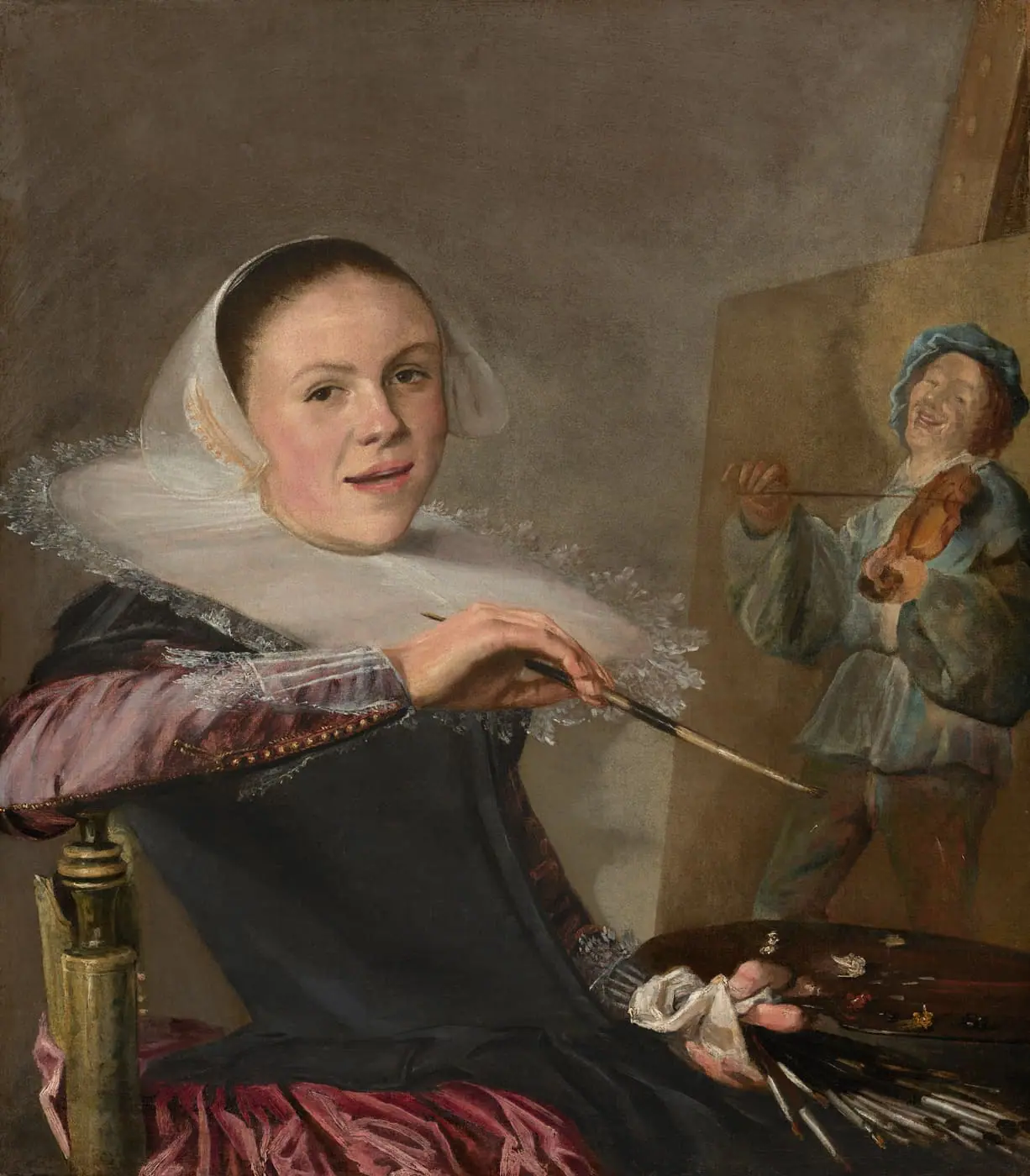
Self-Portrait
Judith Leyster · 1609–1660
3 variations + a matched story print, every standard frame ratio. sRGB · up to 300 DPI · personal-use license.
Print it your way — at home, a local shop, or a gallery print delivered to your door. See the printing guide →
Sizes in the download
Print-ready files at every standard frame ratio below — the full image, nothing cropped:
The print is crisp at 300 DPI up to about 24×36″, and stays sharp at 150 DPI from across the room, out to about 40×60″.
[ Will it fit your frame? ]
THE WORK
A young painter turns at her easel, brush still loaded.
She has swung round in her chair to face out of the picture, one arm slung over the chair-back, the other holding a wide wooden palette and no fewer than eighteen brushes. She wears a stiff lace collar and a fine cap — good clothes, not working ones — yet the paint that makes them is anything but stiff. Look at the cuff and the ruff: the white is dragged on in quick, separate strokes, wet and confident, the weave left half-finished where the light falls off. This loose, slashing touch is the manner of Frans Hals, the great Haarlem portraitist, and for a long time the picture was taken for his.
LOOK CLOSER
Beneath the laughing fiddler lies a face she painted out.
On the easel behind her, a grinning violinist leans into his tune — the merry, mid-laugh figure from the tavern scenes Leyster was known for. He was not the first thing she painted there. Infrared and X-ray examination shows the easel picture began as something else: a young woman with parted red lips — probably a self-portrait — which she painted over with the fiddler. Scholars, and the Gallery itself, read the change as strategic: her merrymaking scenes were her most marketable line, so she steered the easel toward the work that sold.
THE WOMAN MASTER
A name set in the sky, on work long credited to a man.
Leyster signed her paintings with a shooting star — a pun on her surname, which in Dutch means lodestar, the guiding pole star. The confidence was earned: by 1633 she was among the first women admitted as a master to Haarlem’s Guild of St Luke, free to sign work, take pupils and sell under her own mark. Some scholars read this self-portrait, made just before, as the demonstration of skill such standing required. Yet for nearly three centuries much of her output hung under Hals’s name. The barrier was never talent. It was the institutions, as Nochlin wrote — and the market’s long habit of seeing a man’s hand where a woman’s had been.
A true leading star in art.— Theodorus Schrevelius on Judith Leyster
The file & the facts
- Title
- Self-Portrait
- Artist
- Judith Leyster
- Year
- c. 1630
- Medium
- Oil on canvas
- Original
- 74.6 × 65.1 cm
- Collection
- National Gallery of Art, Washington
- Rights
- Public-domain painting · open access · National Gallery of Art, Washington — Gift of Mr. and Mrs. Robert Woods Bliss, 1949.6.1 (CC0, courtesy)
- File
- sRGB · JPEG · 150–300 DPI


