The archive / Cuzco School / Our Lady of Valvanera
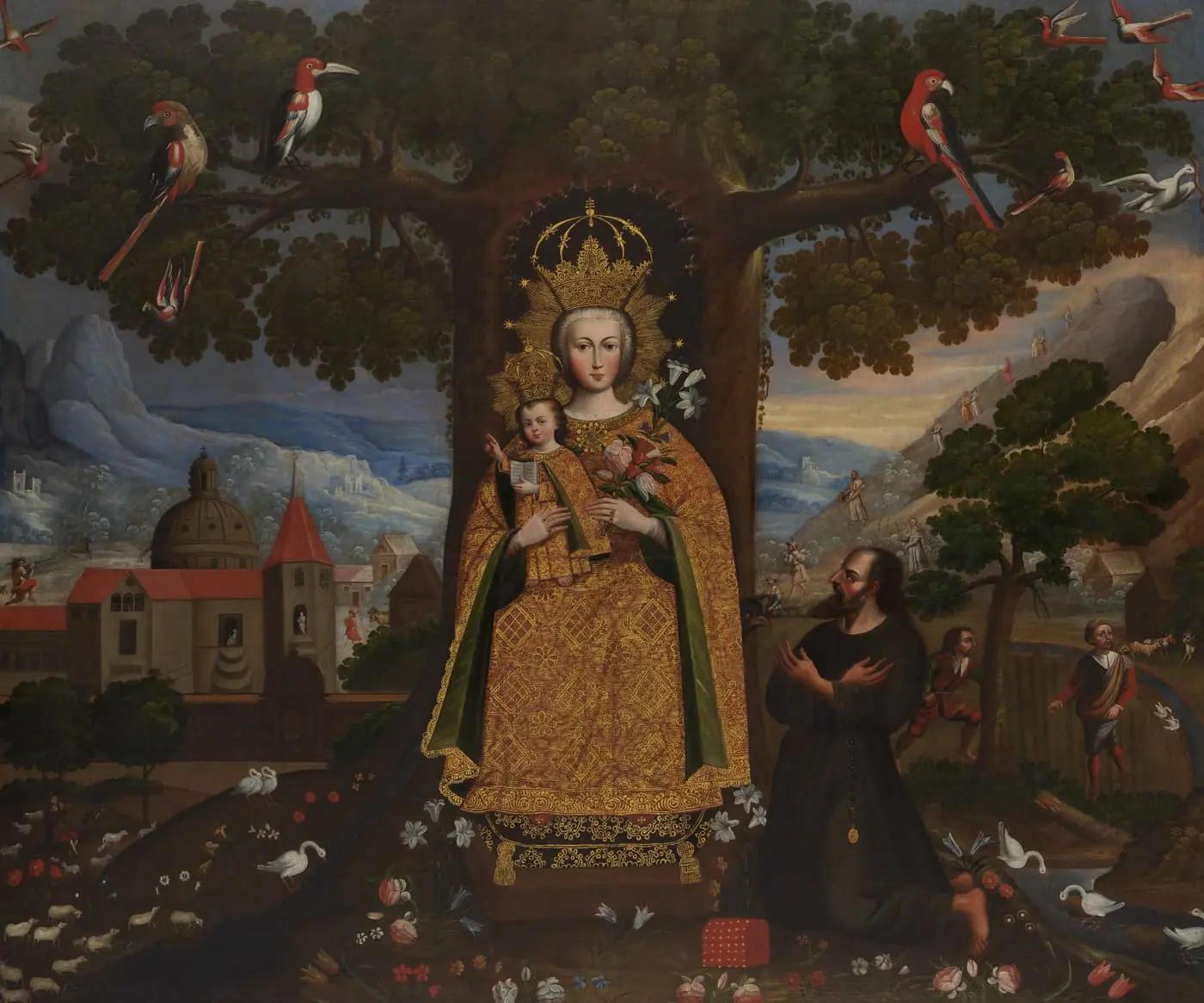
Our Lady of Valvanera
Cuzco School, Peru · anonymous workshop
3 variations + a matched story print, every standard frame ratio. sRGB · up to 300 DPI · personal-use license.
Print it your way — at home, a local shop, or a gallery print delivered to your door. See the printing guide →
Sizes in the download
Print-ready files at every standard frame ratio below — the full image, nothing cropped:
Every size here is print-ready, sharp at viewing distance. Up close, the print is crispest at 300 DPI up to about 8×10″; at larger sizes the cream mat carries the print to the frame while the painting sits at its sharpest within.
[ Will it fit your frame? ]
THE WORK
The light coming off her robe is real gold.
Stand back and the Virgin and her Child glow as if lit from inside. Move closer and you see why: that glow is metal. An anonymous Cuzco workshop laid real gold leaf over the painted robes and tooled it into pattern, a technique called brocateado, so the cloth doesn't depict gold thread so much as carry it. The rest of the canvas is dense and warm around her — a gnarled oak, a small white monastery, tropical birds and flowers crowded to the edges. She sits frontal and still at the centre of all that ornament, crowned, holding the Child, every surface working to make her shine. The picture is over six and a half feet wide. It is built to hold a room.
WHAT THE GOLD IS FOR
A borrowed Spanish saint, remade in Andean terms.
Our Lady of Valvanera is a Spanish devotion; the gold answers a local question. In the Andes, miraculous Virgins were honoured as carved statues dressed in stiff, gold-threaded gowns and paraded in their finery. The brocateado on this canvas reaches for exactly that — paint standing in for a dressed cult image, ornament doing the work of theology. The hand that did it has no name, and that is not an accident. The Indigenous painters of Cuzco had withdrawn from the Spanish-dominated guild in 1688 and built their own workshop style, the Cuzco School, where authorship sat with the shop, not the signature. Anonymity here is a fact of how the work was made, not a measure of who made it.
ON A WALL
A warm, gilded statement piece — at the size it can hold.
This is a colour-forward, gold-rich picture that reads from across a room — the same pull as a Klimt, by way of the Andes rather than Vienna. The crowded oak, the birds and blossoms, the kneeling hermit reward a closer look without needing the legend explained. One honest note on size: the master supports prints up to about 18 by 22 inches, and we cap the ladder there; at the larger end we label it at 150 DPI, still crisp at the distance you'd actually stand. It suits a square or near-square format and an ISO A-series sheet. What it gives a wall is warmth and shine, and a story most people have never seen.
the miraculous discovery of her image in the hollow of an oak tree by a thief-turned-hermit— The Art Newspaper, on the Met's Our Lady of Valvanera, 2019
The file & the facts
- Title
- Our Lady of Valvanera
- Artist
- Cuzco School, Peru
- Year
- c. 1770–80
- Medium
- Oil & gold on canvas
- Original
- 203.4 × 243.5 cm
- Collection
- The Metropolitan Museum of Art
- Rights
- Public-domain painting · open access · The Metropolitan Museum of Art — Gift of James Kung Wei Li, in memory of Ambassador and Mme Ti-Tsun Li, 2018 (2018.652.3, CC0, courtesy)
- File
- sRGB · JPEG · 150–300 DPI