The archive / Natural History / American Flamingo
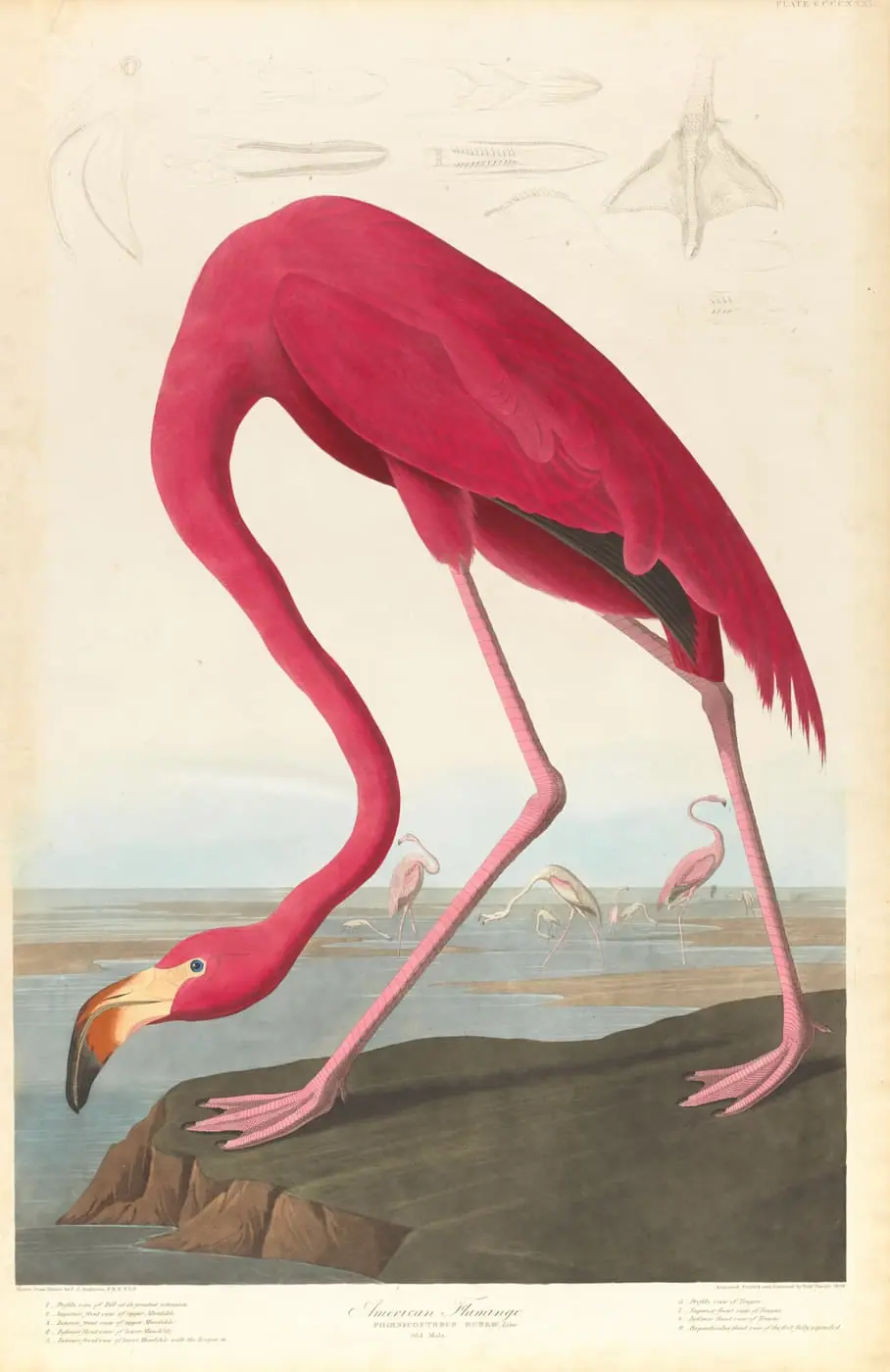
American Flamingo
John James Audubon · 1785–1851
3 variations + a matched story print, every standard frame ratio. sRGB · up to 300 DPI · personal-use license.
Print it your way — at home, a local shop, or a gallery print delivered to your door. See the printing guide →
Sizes in the download
Print-ready files at every standard frame ratio below — the full image, nothing cropped:
The print is crisp at 300 DPI up to about A2, and stays sharp at 150 DPI from across the room, out to about A0.
[ Will it fit your frame? ]
THE WORK
Five feet of bird, folded to fit the page.
One flamingo fills the sheet, and the first thing the eye reads is not anatomy but a line — a single pink contour that bends the whole body into a downward S, the head dropping all the way to the water. Behind it, a thin strip of distant flamingos and low shore. The curve is not a flourish. An adult American flamingo stands close to five feet tall, taller than the largest paper then in commercial use, so Audubon swung the neck down until the animal fit. And the pose is true: flamingos feed exactly this way, head turned upside-down in the shallows, the bill working as a sieve. Necessity and natural fact arrive in the same line.
LOOK CLOSER
Science printed in the margin, colour laid by hand.
In the pale band above the bird float small uncoloured diagrams — the bill in section, the foot, keyed details of the very parts the long pose hides. They are the scientific apparatus, printed right on the plate so the portrait doubles as a specimen record. The colour came after the printing, not in it. Havell’s London workshop pulled the plate as an etching, engraving and aquatint — the aquatint a powdered-resin ground that bites the copper into broad tonal washes — then a team of colourists brushed each impression by hand, the pink built up in layers over that printed grey. Look along the body and you can see where one wash of colour rides over the engraved tone beneath.
THE BOOK
The last birds of a twelve-year project.
The Birds of America ran from 1827 to 1838 and reached 435 hand-coloured plates, every bird drawn the size of life — the rule that set the format. To honour it, Audubon insisted on the double-elephant folio, sheets roughly 39½ by 26½ inches and the largest paper in commercial use, engraved, printed and coloured in London under Robert Havell Jr. Complete sets are now among the most valuable printed books in the world. The flamingo, drawn in 1838 from specimen material after Audubon had seen the birds in the Florida Keys, came near the very end: Plate 431 of 435, the spectacular late close of the work. He saved one of his largest subjects for almost last.
Not only is every object, as a whole, of the natural size, but also every portion of each object.— John James Audubon, Ornithological Biography, Vol. 1 (1831)
The file & the facts
- Title
- American Flamingo
- Artist
- John James Audubon
- Year
- 1838
- Medium
- Hand-coloured engraving & aquatint
- Original
- Sheet c. 101 × 68 cm
- Collection
- Boston Public Library
- Rights
- Public-domain print · open access · Scan: Boston Public Library / Digital Commonwealth · NGA Washington impression released CC0
- File
- sRGB · JPEG · 150–300 DPI


