Why Egon Schiele's Figures Look So Uncomfortable
A naked man hangs in a field of white. One arm is hauled up over his head, the shoulder pulled out of line with the rest of him; his hands and feet darken and thin until they vanish, as if the canvas were trimming the body away at the wrists and ankles. The flesh is a sick yellow-green. And at the eyes, the nipples, the navel and the genitals, small marks of hot red sit on the skin like pins. You feel the discomfort before you can name it.
That feeling is deliberate, and it is not an accident of mood. Schiele built it, choice by choice, out of things you can see and count on the surface of the picture. Once you know where to look, the unease stops being vague and becomes a method.
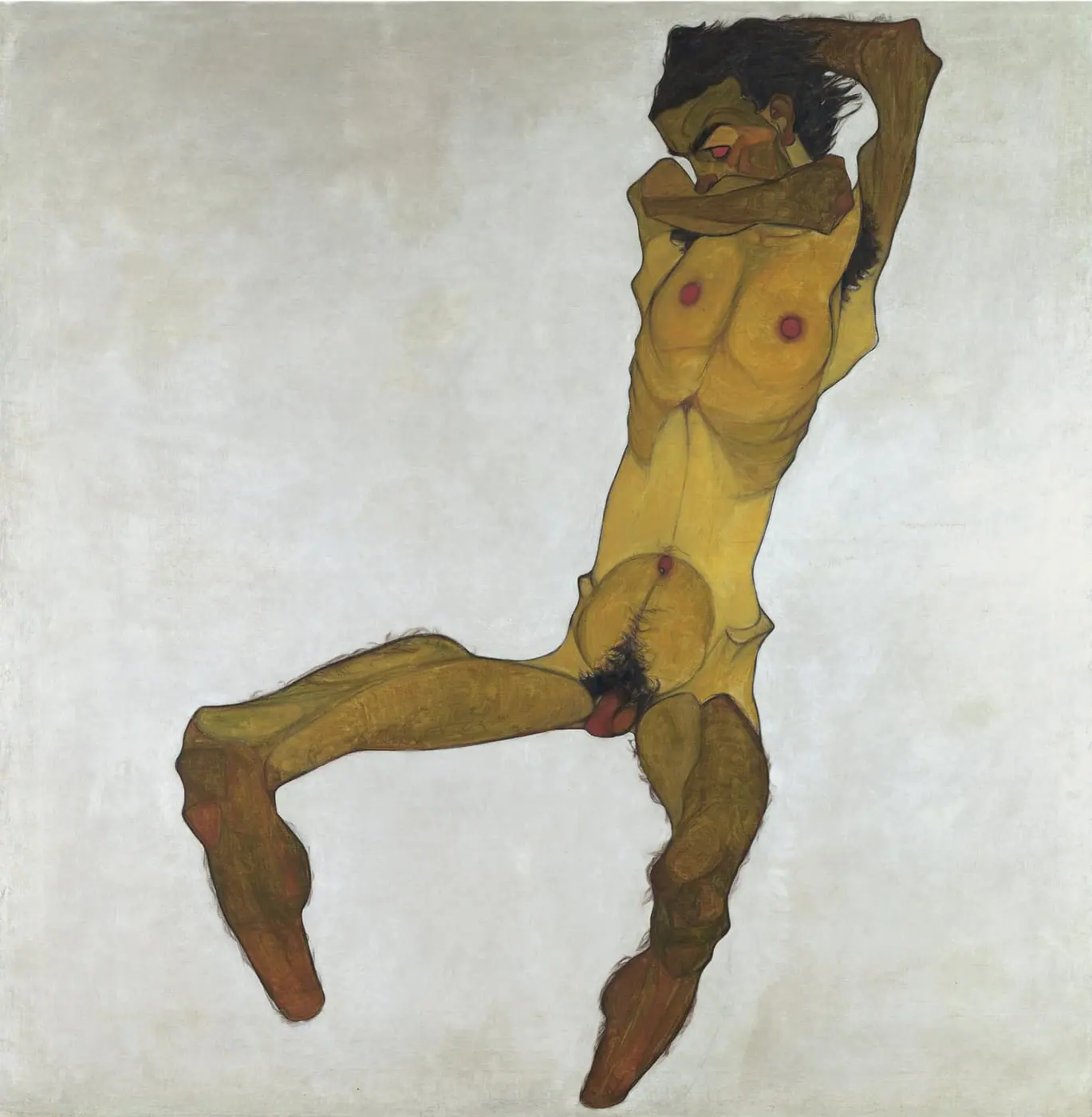
The picture above is our lead exhibit: the Seated Male Nude (Self-Portrait), painted by Egon Schiele in 1910, when he was twenty. It is a near-square canvas, oil and opaque colour, about five feet on a side, and it hangs in the Leopold Museum in Vienna. Hold it in your eye while we take the discomfort apart. Almost everything that unsettles you here recurs across his work, and every device has a name.
1. There is no ground
Start with the title. It says seated. Now look for the seat. There is no chair, no floor, no wall, no horizon, nothing for that word to rest on. The body simply hovers in undescribed white.
This is the first and quietest of the tricks, and the one most people feel without spotting. The Leopold Museum puts it plainly: the body "finds no support in the thinly applied monochrome white of the background," so it "levitates in the placeless pictorial space." A figure with nowhere to stand reads, to the body of the viewer, as a figure that cannot stand: no weight, no balance, no gravity doing its ordinary work. We are built to register footing; deny us the floor and the picture feels precarious before we have looked at the man at all.
Schiele used that empty ground again and again. Strip away the room, the props, the setting that a nineteenth-century nude would have lain comfortably inside, and the figure is left exposed on bare paper or canvas, with nothing to lean the eye against. The void is no lazy, unfinished background. It is the stage he chose: a place where a body can only float.
2. The pose is one a body can't hold
Look at the shoulder. The arm is clamped up over the head, and the joint beneath it sits wrong, wrenched out of its natural line, the socket twisted past where it wants to go. Try to take the pose yourself and you find it: a position you could snatch for a second, not one you could settle into. The body is caught at the edge of strain.
This is the second device, the dislocated, over-torqued pose. Schiele bends his figures into shapes that read as effort, even pain: limbs cranked at the joint, spines kinked, hands flexed into claws or splayed flat. We read other bodies with our own, mirroring them without meaning to, so a pose that would hurt us transmits as a pose that hurts him. The contortion isn't decoration laid over a calm figure. It is doing the unease directly, through the joints.
3. The hands and feet are stumped off
Follow the arms and legs out to their ends. The hands and feet don't resolve into fingers and toes; they darken, thin, and dissolve into stumps, as though the edge of the canvas were lopping the body off at the wrist and the ankle.
That is the third device, and it lands as a specific kind of dread. Hands and feet are how a body grips and stands, how it holds on and holds itself up. Take them away and you remove the figure's purchase on the world twice over: it can neither grasp nor plant itself. Cropping a limb at the frame's edge is an old compositional move, used by plenty of painters to suggest a world continuing past the picture. Schiele turns it to the opposite end. His croppings don't open the body onto a larger world; they amputate it, leaving the figure curtailed, partial, without grip.
4. The red marks where an anatomist sets the pins
Now the marks that fix you. The flesh is modelled so that tendon, muscle and bone seem to press up through the skin; the Leopold Museum's phrase is that the body is made to look almost skinned. The almost matters: this is paint suggesting the flayed body, not a literal anatomical study. Then come the points of red, set at the eyes, the nipples, the navel and the genitals, pricked onto the skin like an anatomist's pins planted in a specimen.
This is the fourth and most aggressive device, and it does work the missing background can't. With no room around the figure and no shadow beneath it, there is nothing to lead your eye, so the red leads it: straight to those few flagged points on a hovering body. The colour functions almost diagrammatically, marking the body the way a teaching plate marks the parts it wants you to study. The effect is the most exposed a painted nude can be: skin opened, organs flagged, and nowhere to stand while we look. The vulnerability isn't suggested. It is pointed at, in red.
So this is a tortured mind on canvas?
It is the obvious reading, and it is the wrong one. The temptation is to take all this strain and exposure as symptom: the raw overflow of a troubled psyche, art as involuntary confession. Schiele's later life supplies the cliché's fuel: in 1912 he was briefly jailed at Neulengbach in a case involving his drawings, and the tortured-genius story has fed on it ever since.
But the distortion came first, and on purpose. This canvas is from 1910, two years before that episode, made by a twenty-year-old in full command of what he was doing. The wrenched joint, the stumped hands, the flagged organs, the floating void: these are deliberate, repeated, refined across many works, not a hand shaking under the weight of feeling. The proper name for the program is Expressionism, the early-twentieth-century turn, strongest in German-speaking Europe, that put inner feeling and psychological truth ahead of faithful appearance and bent colour, line and the body itself to get there. Schiele is doing in paint what the label promises: distorting the visible to make the felt visible. Smarthistory frames exactly this, his willful distortion as an Expressionist innovation, not symptom. An artist this in control of his discomfort is not its victim. He is its author.
It helps to see what he was reacting against. Schiele came up in the Vienna of Gustav Klimt, who spotted him early, traded drawings with him, and opened doors. Set this nude beside Klimt's The Kiss and you can read the rebellion in full: Klimt wraps the body in gold leaf, pattern and ornament until it half-dissolves into a beautiful surface; the young Schiele scrapes all of that off and paints what the gold was hiding, sinew, joint, organ, the anxious animal underneath. Same city, one generation apart, opposite instincts. They are bound together at the end, too: both gone in 1918, within months of each other, Klimt in February and Schiele that October, at twenty-eight. For the broader nerve Schiele was pressing, the body and face as raw feeling rather than fine surface, the catalogue's other great Expressionist cry — Munch's The Scream — is the obvious companion.
The twist that makes it worse
Here the picture turns the screw one last time, and the turn is recent.
The work carries the title Self-Portrait, and the museum still presents it that way. But look at the head: the face is barely there, generalized almost to a blank. And these 1910 male nudes, Schiele's so-called Red Men, are now contested ground. Jane Kallir, who keeps Schiele's catalogue raisonné, argues they are not self-portraits at all but portraits of other men. The faces, she suggests, were left blank on purpose: to conceal the identities of friends and models such as Erwin Osen and Max Oppenheimer, at a time when sex between men was a crime in Vienna.
It is an argument, not a verdict, and worth holding as one: the title stands, the museum keeps it, and the case is built on the look of the pictures rather than a signed confession. But sit with what it does to the unease. We have spent this whole picture watching a body stripped of its setting, its footing, its grip, its very skin. Now it may be stripped of the last thing too: the certainty of whose body it is. A nude this exposed, and we cannot be sure who it shows. That is the final discomfort, and Schiele could not have planned it: a figure laid so bare that, a century on, its own identity has come loose.
So the next time a Schiele stops you cold, you can read the chill instead of just feeling it. No floor, so it falls. A joint out of true, so it strains. No hands, so it can't hold on. Red pins, so the eye goes to the wound. It was engineered, not emoted, and that, finally, is the unsettling thing. The discomfort is not the accident of a troubled life. It is a design, drawn with a very steady hand.
See the work, with its full sourced story, on its page in the archive. It belongs to the broader turn explained in our guide to Expressionism, and it reads against the grain of its own Vienna — Schiele's mentor Klimt wrapped the body in gold in The Kiss, where the young Schiele scraped it down to sinew. For more on the artist, see his page.
Le Stampe is open. The print is available, $9 — a museum-grade, print-ready download of the Seated Male Nude, with the story behind it. See the print, or browse the archive.
Image: Egon Schiele, Seated Male Nude (Self-Portrait), 1910, oil and opaque colour on canvas, 152.5 × 150 cm. Leopold Museum, Vienna (Inv. 465). Public domain.