The Hidden Blue in Girl with a Pearl Earring (and Why Her Name Was Never the Point)
She turns toward us, lips just parted, as if we have said her name and she has half-decided to answer. For three and a half centuries that look has held people to the same question: who is she?
The short answer is stranger than any of the guesses. We do not know her name, and the picture was never intended to preserve it. A real girl may have posed, but Vermeer was not painting her portrait. He was painting a type. Once you see what kind of picture this actually is, almost everything shifts: the blue you are looking at, and the pearl that, strictly, isn't there.
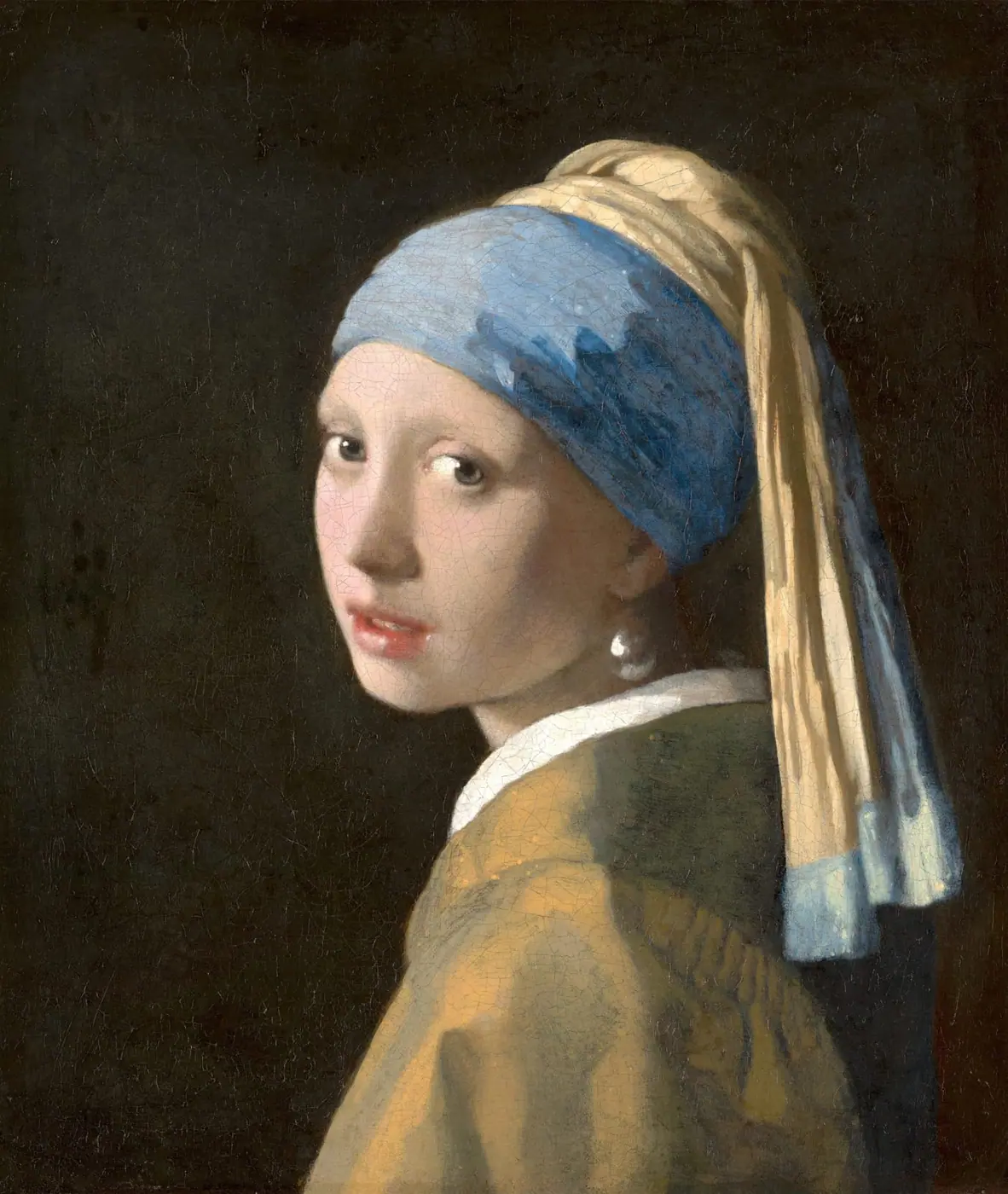
She is a tronie, not a portrait
A portrait is a likeness of someone who sat for it. This is a tronie, Dutch for roughly "face" or "mug," a kind of picture popular in the seventeenth-century Netherlands that studies a face as a type, for its character, its costume, its play of light, rather than recording a named sitter.
The popular imagination keeps collapsing that distinction. The 1999 novel and the 2003 film gave her a name, Griet, and a whole life as a servant in Vermeer's house. They are lovely fictions, and they are fiction. Look at what she wears: an "oriental" turban in blue and lemon-yellow, and an improbably large pearl. No respectable Delft woman dressed like this. The costume is a studio invention, a fantasy of the exotic, the cue that told a contemporary viewer, at a glance, that this was a tronie and not some burgher's daughter.
So the right question was never who is she. It is what is she: an idea of a face, caught in the act of turning. That she feels like someone you have almost met is not an accident. It is the achievement.
The most precious thing in the picture is the blue
Now look at the turban. That deep, cool blue is ultramarine, the most expensive pigment a painter could buy in Vermeer's day, ground from lapis lazuli, a semi-precious stone hauled overland from the mines of what is now Afghanistan. Ounce for ounce in the seventeenth century, good ultramarine cost more than gold.
"It's surprising how much high quality ultramarine Vermeer used in the girl's headscarf. This blue pigment was more valuable than gold in the 17th century." — Abbie Vandivere, Mauritshuis conservator and lead of the 2018 Girl in the Spotlight study
That is the quiet extravagance of this small canvas. Vermeer was not a rich man, and tronies were not prestige commissions. Yet he reached for the costliest blue on the market and spent it freely, not only on the surface of the turban but down into its shadows, so the cloth keeps its colour even where the light leaves it. A cheaper painter darkens blue with black and lets the shadows go grey and dead. Vermeer set the expensive pigment to do the shadow work. The turban glows from within because he paid for it to.
There is a small art-historical lesson in that. The "hidden blue" of the title is no secret message. It is a value judgement Vermeer made with his own money, plain to anyone who knows what they are seeing.
The background you see is not the one he painted
Here the picture has genuinely changed since 1665. Today she floats against a flat, near-black void, and that emptiness is part of why she seems to belong to no particular time. But the dark was not Vermeer's intention.
The 2018 "Girl in the Spotlight" project, a two-week campaign of non-invasive imaging and analysis led by the Mauritshuis, found that the background was originally a green curtain. Macro X-ray fluorescence scanning caught the pigments Vermeer used, indigo and the yellow weld, and the imaging even recovered faint diagonal folds in the upper right: the ghost of hanging cloth. Over three centuries the translucent green paint changed, chemically and physically, flattening into the dark we now read as void.
This does not mean the painting was "wrong" or badly made; slow change is the fate of organic pigments. It means the picture we love is, in part, the work of time as much as of Vermeer. She was meant to stand in a real, shallow space, in front of fabric, not in the eternal black we now find so haunting. We are moved by a happy accident of decay.
The same study found something tenderer still. Vermeer painted fine eyelashes around both eyes, almost invisible to the naked eye today. He built the intimacy of her gaze out of details he knew you would never consciously see.
The pearl that isn't there
Look hard at the famous earring and the trick comes apart in your hands. There is no pearl. There is paint, essentially two strokes: a bright, soft highlight at the upper left, where a window catches it, and a dim glow on the underside, where the white of her collar reflects back up. That is the whole pearl.
And there is no hook, no wire, no contour line where pearl meets ear. Vermeer didn't draw the object and fill it in; he painted only the light the object would throw, and trusted your eye to assemble the rest into a smooth, weighty sphere. Pearls that large and that flawless almost certainly didn't exist in Delft anyway; like the turban, it is part of the fiction. This is his method in a single touch: he paints not things but the behaviour of light on things.
Why she still stops you
Step back and the parts cohere into one idea: this is a picture about the moment of turning. She is caught between facing away and facing us, head pivoting over the shoulder, eyes already arrived though the body hasn't. The composition is almost violently simple. One figure. One strong light from the left. No setting to distract you, and now, thanks to the faded curtain, truly none. Every choice serves that turn: the way her cheek dissolves into the dark with no hard line, sfumato; the wet shine on her lower lip, two flecks of paint; the cool blue turban set against the warm yellow jacket, each making the other burn a little brighter.
Her name was never the point. Vermeer wasn't recording a person; he was making the experience of being looked at, and looking back. Painted around 1665 in the small Dutch city of Delft, and quietly hanging in the Mauritshuis in The Hague since 1902, she has outlasted every real face of her century. A portrait preserves one person. This preserves the feeling.
See the work, with its full sourced story, on its page in the archive. She shares the same hushed, inward register as Hammershøi's Interior, Strandgade and Cassatt's The Child's Bath — quiet interiors that reward a long look. If you want to live with her, our printing guide covers sizes, paper and framing for a canvas meant to be seen up close.
Le Stampe is open. We make print-ready downloads of public-domain masterpieces — each with the story behind it. Browse the prints, or join the list for new drops. No spam, just the art.
Image: Johannes Vermeer, Girl with a Pearl Earring, c. 1665, oil on canvas, 44.5 × 39 cm. Mauritshuis, The Hague. Public domain.