How to Look at a Hockney Without Saying "Joy" Too Quickly
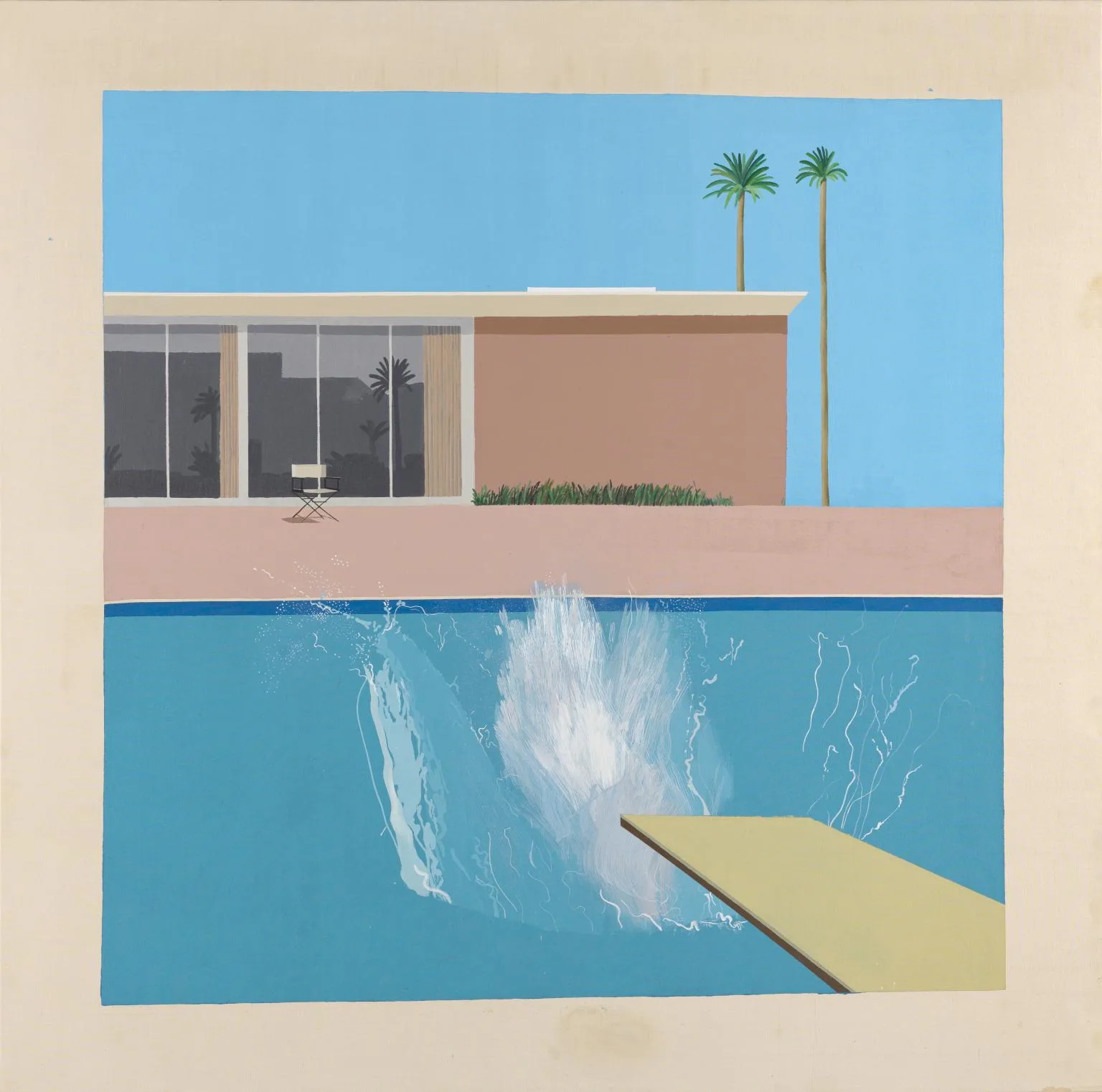
The pool is still. The house is still. The chair is still. Only the water has misbehaved, thrown up into a white burst where a body has already vanished.
That is the trick of A Bigger Splash, and it is a good place to begin today because the obvious word is too small. David Hockney's pictures are often called joyful, and the word is not wrong. The blue really does arrive first. The sunlight is clean, the edges are sharp, the rooms are readable, the colour seems to have no shame in it. But if joy is where you stop, the pictures flatten into postcards of themselves.
Hockney died at home on June 11, 2026. He was 88, one month short of his 89th birthday. The tributes have reached, naturally, for the bright words: pleasure, colour, vitality, California, looking. Keep them. Then look again.
The Splash Is an Absence
Start with the missing body. In A Bigger Splash, the diver is the only event in the picture, and the diver is not there. We arrive after the leap and before the surface closes. A painting famous for leisure is also a painting about aftermath.
That small delay matters. The pool pictures made Hockney's Los Angeles look like a country of permission: flat roofs, blue rectangles, private water, male bodies, white sun. For an English painter born in Bradford in 1937, who came of age before sex between men was partially decriminalised in England and Wales, California meant weather and also a visible form of elsewhere. The pool gave him a way to paint desire without hiding it under allegory.
But the splash does not only say freedom. It says time. Hockney fixes a thing that cannot hold still, then empties the frame of the person who caused it. The painting lets you have the pleasure of the blue and the little wound of absence at the same time. That doubleness is everywhere in him once you stop asking the pictures to be happy on your behalf.
Pleasure Was Never Neutral
The early queer paintings sharpen that point. We Two Boys Together Clinging, painted in 1961 and titled from Walt Whitman, is not a sunny pool scene. It is rougher, wordier, closer to graffiti and confession, made while Hockney was still a student at the Royal College of Art. It matters because it shows the bravery that later brightness can disguise. Before the pools became museum icons, the subject was already clear: men loving men, painted in public before public life had made much room for that truth.
So when the California works arrive, their pleasure is not innocent decor. It is a claim. A body in water, a shower, a pink jacket beside a pool, a young man climbing out into sun: these are pictures of looking that know looking has consequences. Hockney's flat colour can make the scenes feel easy, but the ease is earned against a world that had not granted it.
That is why joy, by itself, is thin. It forgets pressure. Hockney's best brightness is not cheerfulness spread over the surface; it is clarity after concealment. The colour is open because so much else had been closed.
The Room Is Not a Mood
Then there are the interiors, where the distance between people becomes architectural.

In Mr and Mrs Clark and Percy, the window is the brightest thing in the room and the loneliest. Celia Birtwell stands on one side, Ossie Clark sits on the other, and the open shutters pull the eye straight through the marriage into the air beyond it. The white cat, neat on Clark's lap, refuses the viewer and looks out instead. Everything is elegant. Nothing quite touches.
That is Hockney's domestic intelligence. He knows that rooms are not containers for people; they are diagrams of relation. A chair can tell you who has settled in. A window can tell you where the emotional exit is. A rug, a lamp, a vase, a strip of bright outdoor light: all of them participate.
My Parents, painted in 1977, is quieter still. His mother sits upright with her hands in her lap. His father bends over a book, present and elsewhere at once. Between them, on a trolley, sits a mirror reflecting a sliver of reproduction. The painting is affectionate, but not sentimental. It lets two people occupy the same room in different kinds of attention. Hockney's tenderness is exact because it does not pretend closeness solves separateness.
The Collector Pictures Know the Joke
The sharper version of that room logic appears in American Collectors (Fred and Marcia Weisman), a painting that looks at wealth with a smile too dry to call affectionate.

The Art Institute of Chicago's catalogue describes Fred and Marcia Weisman standing in the sculpture garden of their Los Angeles home, stiff among the objects they own. That is the comedy, and the sting. The couple are almost sculptures themselves, placed among sculpture, lit by that hard Southern California brightness until the whole scene feels flattened and staged. Hockney gives you pink, green, blue, sun, glamour. Then he lets the glamour turn awkward.
This is one reason his popularity should not be mistaken for softness. He made legible pictures, but legibility is not the same as reassurance. He wanted the eye to enter quickly; he did not promise it would leave untroubled.
He Made Looking Mechanical
Hockney kept mistrusting single-point vision. That is one of the great continuities of his career, from the pool paintings to the photo-collages, from stage sets to iPad drawings. He did not move from tradition to technology as if the old tools had failed. He treated every tool as a new argument about how sight works.
The joiners, especially, refuse the fiction that one glance is enough. A road, a living room, a face, a chair: all of it arrives in pieces. In works such as Pearblossom Hwy., 11-18th April 1986, #2, the road is built from many photographs taken from slightly different positions, so ordinary space begins to behave like a Cubist memory. You do not see the scene from a god's point of view. You see it by moving through it.
That is a useful way to read the whole career. Hockney's art keeps asking how a person sees when a person has a body: walking, turning, remembering, desiring, ageing, using whatever device happens to be in hand. The camera is not the enemy of painting. The iPad is not a gimmick. The brush is not sacred because it is old. The question is always whether the tool wakes the eye up.
The Late Pictures Are Not a Victory Lap
Late Hockney can be easy to patronise: flowers on screens, trees in Yorkshire, blossom in Normandy, colour as if the world had been freshly washed. That is a mistake. The late work is moving because it refuses the usual bargain offered to old artists: repeat your famous manner, or become dignified and dim.

Bigger Trees Near Warter is not a postcard landscape. Tate records it as oil paint on 50 canvases with 100 digital prints on paper, and the scale matters because the painting is too large to take in as one tidy view. Your eye has to travel. The branches fork and clutter, the road pulls forward, the hedgerow thickens, and the winter light gives almost nothing away. It is a picture about looking at something ordinary until the ordinary becomes too complex to summarise.
That, more than optimism, is the late lesson. Hockney kept making attention look active. He did not treat ageing as a retreat from experiment. He made old age a studio condition: more time spent with trees, more seasons watched, more devices tested, more pictures made from the fact that the world had not run out of appearances.
Joy Is the First Word
So say joy, but say it after the looking has earned it.
Say it after the absent diver. Say it after the lovers painted before the law had caught up to them. Say it after the window between Clark and Birtwell, after the father bending into his book, after the Weismans turned into part of their own sculpture garden. Say it after the joined photographs have broken one glance into many. Say it after the late trees have made a winter hedge feel too large for the eye.
Then the word changes. Joy is no longer a bright label pasted over the work. It becomes a discipline, a way of refusing dullness without refusing grief, loneliness, awkwardness, age, or loss. Hockney's gift was not that he made the world cheerful. It was that he made looking feel alive, and insisted that aliveness was serious.
The pool is still. The splash is still there. The body is gone.
Keep looking.
Editorial image note: Hockney's works remain copyrighted. The images above are compressed web-resolution reproductions included in an editorial tribute for criticism, comment, and news context. They are not Le Stampe products, downloads, shop assets, or print files.
Image credits: David Hockney, A Bigger Splash, 1967, acrylic paint on canvas, Tate T03254. Web image: Tate. Copyright David Hockney. David Hockney, Mr and Mrs Clark and Percy, 1970-71, acrylic paint on canvas, Tate T01269. Web image: Tate. Copyright David Hockney. David Hockney, American Collectors (Fred and Marcia Weisman), 1968, acrylic on canvas, Art Institute of Chicago, 1984.182. Web image: Art Institute of Chicago IIIF. Copyright David Hockney. David Hockney, Bigger Trees Near Warter or/ou Peinture sur le Motif pour le Nouvel Age Post-Photographique, 2007, oil paint on 50 canvases and 100 digital prints on paper, Tate T12887. Web image: Tate. Copyright David Hockney. OG portrait: Helmut Newton, Portrait of David Hockney, Los Angeles, 1988, gelatin silver print; web image via Christie's lot record, cropped for social preview.
Sources checked: The Guardian and AP reports published June 12, 2026; Tate collection records for A Bigger Splash, Mr and Mrs Clark and Percy, My Parents, and Bigger Trees Near Warter; Art Institute of Chicago record for American Collectors (Fred and Marcia Weisman); Christie's lot record for Helmut Newton, Portrait of David Hockney, Los Angeles, 1988; U.S. Copyright Office fair-use guidance.